Same Driveway, Three Different Numbers
Memphis concrete work starts at $1,600 for a basic sidewalk, with per-square-foot costs of $7 to $15 depending on project type and finish. Driveways, pool decks, and foundation repairs can push projects to $15,000.
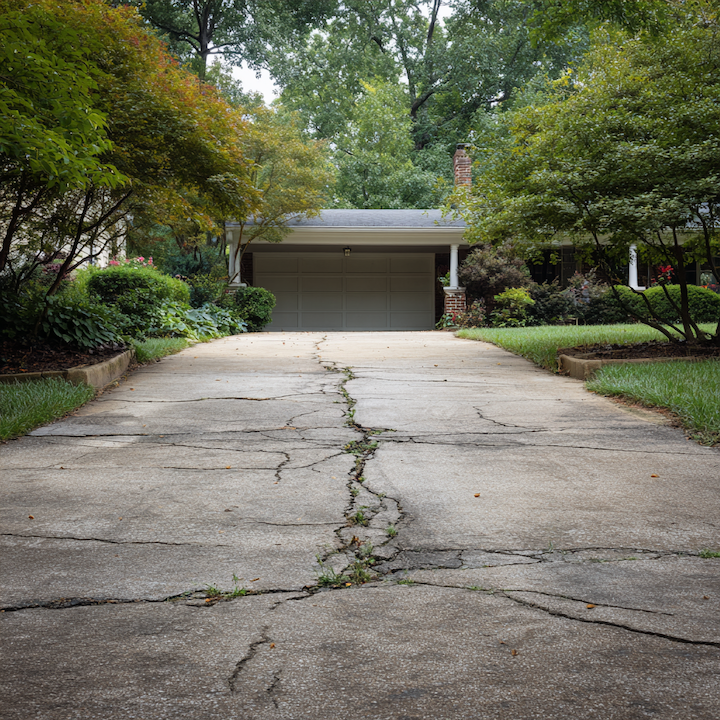
Three quotes spread across a kitchen counter in Germantown last spring. Same driveway. Same 600 square feet. Same address.
$3,200. $4,700. $8,200.
The homeowner had called the middle contractor back to make sense of it.
"I'm not trying to waste your time," she said. "But somebody's way off here."
He picked up the low quote and turned it toward her. "This one's a pour on existing soil. No excavation, no gravel base, no rebar. They're pouring directly on Memphis clay."
"And yours?"
"Excavate, lay 6 inches of compacted gravel, pour 5 inches of concrete over a rebar grid, and cut control joints." He set the two quotes side by side. "The cheap pour cracks within two years on this soil. That's not a price difference. That's a completely different job."
She picked up the high quote. "And this one?"
"Stamped decorative finish. Color hardener, pattern work, sealer coat. Same base prep as mine, different surface."
She looked at the three sheets of paper for a long time. Three numbers. Three different driveways. The only thing they had in common was the address.
Concrete work in Memphis runs $7 to $15 per square foot. The ground underneath -- base prep, thickness, rebar, and soil conditions -- accounts for most of the spread. But knowing what separates a $3,200 pour from a $4,700 pour starts with the dirt it sits on.
The Soil
A driveway in Cordova had been down six months when the crack appeared. A quarter-inch line running diagonally across the center of the slab, visible from the garage.
The homeowner pointed at it from the doorway. "It was fine when they finished. Six months. That's all it took."
The contractor crouched at the edge of the crack and pressed his thumbnail into the seam. "Feel the slab," he said. "Put your hand flat."
She knelt down and placed her palm on the concrete. "It's not level anymore."
"It was level when they poured it." He stood up and looked at the yard. The grass along the driveway edge was spongy, saturated from the previous week's rain. "Memphis sits on Yazoo clay. Swells when it's saturated, shrinks when it dries. That cycle doesn't stop. Your crew poured directly on it."
"I paid $3,500 for this driveway. Nobody said anything about the dirt."
"Compacted gravel. Four to six inches of it between the clay and the concrete. Absorbs the movement so the slab doesn't have to." He tapped the crack with his boot. "Skipping it saves a dollar or two a square foot on a pour that doesn't last five years."
She stared at the crack. "So this isn't a concrete problem."
"It never was."
A standard broom-finish driveway on properly prepped ground runs $7 to $9 per square foot in Memphis. The slab is only as stable as what's underneath it -- and what's underneath it in Memphis is clay that never sits still.
Base and Thickness
A patio in Whitehaven had been poured on packed dirt the previous summer. No gravel, no base prep. The homeowner had saved $800. Within a year, two corners had lifted and a crack split the center slab.
He was standing on it when the contractor arrived.
"I already know what you're going to say," the homeowner said.
The contractor walked the perimeter, checking edges. He pressed his foot against the lifted corner and it rocked. "Who poured it?"
"Guy from a Facebook ad. Cash deal."
"Base?"
"He said packed dirt was fine for a patio."
The contractor shook his head slowly. "A proper base runs 4 to 6 inches of compacted gravel underneath the slab. Driveway needs 5 to 6 inches of concrete on top of that. Patio can get away with 4 inches, but not on raw dirt." He pointed at the lifted corner. "Each extra inch of concrete adds $1 to $2 per square foot. Rebar adds another $1 to $2. On Memphis clay, both are the difference between a slab that settles and one that holds."
"So this one's done."
"This one was done before the first freeze." He pulled out his phone and knelt at the edge to measure. "300 square feet. Tear-out, haul-off, gravel base, rebar grid, 4-inch pour." He punched numbers. "You're looking at $1,900 to $2,600 for the repour alone."
The homeowner closed his eyes for a second. "Plus the $800 I already spent."
"Plus the $800."
A medium patio on proper base runs $1,900 to $2,600 at standard finish in Memphis. The base prep and thickness that seem like extras on the quote are the parts that keep the slab in one piece -- and the parts that show up first when they're missing.
Cracks
A homeowner in Bartlett called a contractor about replacing her driveway because of hairline cracks. He drove out expecting the worst. What he found was cosmetic.
"Show me," he said.
She walked him to the worst section and pointed. "These. They're everywhere. I've been sick about it."
He crouched down and ran his finger along one. "How long have you had this driveway?"
"Four years. And I've watched these spread every summer."
He pulled a quarter from his pocket and held it against the crack. The coin edge was wider than the line. "Anything under a quarter inch is normal. Control joints are cut into the slab specifically to direct where cracks form. These went where they're supposed to go."
"Four years of worrying about nothing?"
"Four years of a driveway doing exactly what concrete does." He stood up and pocketed the quarter. "Cracks wider than a quarter inch tell a different story. That's movement underneath -- not surface wear. But yours are textbook."
She looked at the driveway for a long time. "I almost called someone to tear this whole thing out."
"At $7 to $9 a square foot, that would've solved a problem that didn't exist."
Not every crack is a failure. But the line between cosmetic and structural runs about a quarter inch wide -- and the difference between watching it and replacing it can be thousands of dollars. The question changes when a slab starts to sink.
Repair or Replace
A homeowner in East Memphis watched one corner of his patio sink a half inch over two summers. He assumed the slab was failing and called for a replacement quote.
"$3,200 to tear out and repour," the first contractor told him.
The second contractor walked the yard before he wrote anything down. He circled the patio twice, crouched at each corner, then stopped at the back edge.
"Where's your downspout drain?" he asked.
"Right there." The homeowner pointed to a gutter spout emptying directly against the patio edge.
The contractor held his hand under the spout and looked at the soil line. Dark, saturated, soft. "That's your problem. Water's been saturating the clay underneath this corner for years. The clay compresses under the slab, and the concrete follows it down."
"So the patio's not failing."
"The drainage is failing." He stood up and wiped his hand on his jeans. "Redirect the downspout, lift the slab, and you're done. Downspout extension runs about $200. Foam injection to lift the corner runs $1,000 to $2,500. Mudjacking is $500 to $1,500 if you go that route."
The homeowner did the math out loud. "So $1,200 to $2,700 versus ripping it out and starting over."
"And the $3,200 repour sinks the same way if the downspout stays where it is."
Full replacement on a standard driveway or patio runs $7 to $9 per square foot in Memphis. But not every sinking slab needs replacing. Sometimes the concrete is fine and the water is the problem -- and fixing the water costs a fraction of fixing the slab. The work itself, though, is only as good as when it happens.
Timing
A crew in Midtown poured a patio in July. Air temperature hit 97 degrees by noon. The surface dried faster than the interior could cure, and hairline cracks spiderwebbed across the finish before the crew left the site.
The homeowner ran her hand across the surface the next morning. Rough. Webbed. Nothing like the smooth broom finish she'd been shown in photos.
"It looks like a spiderweb," she told the contractor on the phone. "The whole surface."
"It's structurally fine," he said. "The heat pulled the moisture out of the top layer before the inside could catch up."
"Then why does it look like it's falling apart?"
He drove out that afternoon. He knelt on the slab and poured a cup of water on the surface. It pooled in the web pattern instead of sheeting off. "See that? The surface is crazing. Concrete doesn't cure by drying. It cures by holding moisture. Anything above 90 degrees accelerates surface drying and risks exactly this."
She watched the water sit in the tiny cracks. "Can you fix it?"
"Resurface, yeah. But it shouldn't have happened." He looked at the patio for a long moment. "I should've pushed the pour to October."
"So timing matters that much?"
"Spring and fall give the slab time to cure evenly. 50 to 80 degrees is the window. Winter pours work but need blankets and additives that add to the cost." He stood up. "Summer is the gamble. And this one didn't pay off."
Memphis summers push concrete past its curing window. A perfectly prepped base, the right thickness, quality rebar -- none of it matters if the calendar is wrong. The spec sheet has a date on it for a reason. But specs and prep and timing still leave one question the homeowner can't answer alone.
The Contractor Question
A couple in Germantown did everything right last fall. Three quotes. Three companies with Google reviews and professional websites. Crews that showed up on time and said all the right things about base prep and rebar and cure times.
They still had no way to know.
No way to tell which crew would answer the phone when the first crack appeared. No way to know if the installer actually carried workers comp or just said he did. No way to verify a license number they wouldn't think to ask for.
That's the gap this platform exists to close.
The concrete contractor connected through here holds an active Tennessee Board for Licensing Contractors license with a monetary limit of $25,000 or higher. They carry $100,000 in general liability insurance and workers compensation for every crew member on the site. Their references were called, not collected. Their license was verified directly with the state. They were vetted in person by someone with more than two decades in Memphis construction.
That's the part that doesn't show up in a Google search.
Most estimator sites work by collecting your contact information and selling it to three to five contractors who then compete for your business with aggressive follow-up calls. This platform works differently. When you request a contractor introduction, we match you with one concrete professional whose licensing, insurance, and work history have already been verified. One contractor, one homeowner, one conversation. No bidding wars and no phone spam.
The estimator itself requires nothing from you. No account creation, no email address, no phone number. Run as many estimates as you want, adjust the scope, compare finishes and thicknesses -- all of it happens in your browser using current Memphis pricing data. Your information stays yours until you decide otherwise. The only time we ask for contact details is when you choose to connect with a verified contractor for a formal bid.
Concrete work often connects to larger yard projects. New patios pair naturally with decks for multi-level outdoor living, and fencing defines the space once the flatwork is done. Settling concrete sometimes signals deeper foundation issues worth investigating. Pool decks and coping are part of pool construction projects, and staining or sealing flatwork pairs with exterior painting schedules. When a driveway or patio cracks within months of being poured due to improper subgrade preparation or insufficient reinforcement, a construction attorney can determine whether the contractor's workmanship falls below the standard required by the contract.