The Diagnosis and the Price
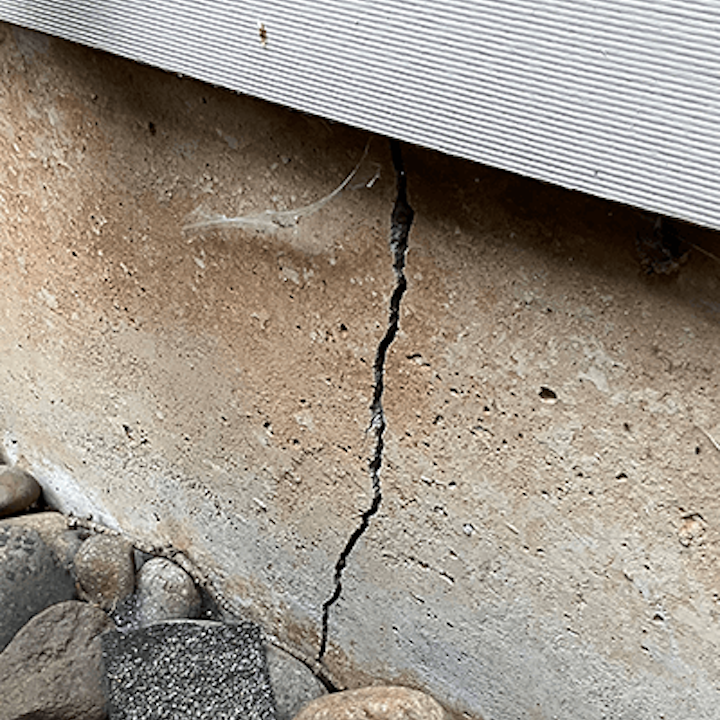
Memphis sits on Yazoo clay, one of the most expansive soil types in the country. The same soil that holds a slab steady in January can swell 30 percent by July and push a basement wall inward by fall. Every house in the metro rides that cycle. Some ride it fine for decades. Others start showing cracks in the first five years.
Foundation repair in Memphis runs $2,200 to $50,000 or more depending on what's actually wrong and how much of the house is affected. A single crack seal on a poured concrete wall costs a fraction of what full-perimeter pier installation costs. But those two jobs share a name, and the gap between them is entirely diagnostic. The same crack in two different houses can mean two different things.
What separates a $2,200 repair from a $50,000 one isn't the materials or the labor. It's what somebody measured before the work started.
Reading the Cracks
A homeowner in Frayser called a contractor out to look at a crack running diagonally up his basement wall. He'd traced it with a pencil six months earlier and written the date beside it in permanent marker.
The contractor crouched down and studied the pencil line.
"It hasn't moved," the homeowner said. "I've been checking it every week."
"I can see that." The contractor stood up and pressed his palm flat against the wall. He held it there for a few seconds, then stepped back. "Wall's plumb. No bowing. This is a shrinkage crack. Poured concrete does this."
The homeowner exhaled. "So I can stop waking up thinking about it?"
"You can. These don't progress. Shrinkage cracks form in the first few years and stop."
"What would make you worried?"
The contractor ran his hand horizontally across the wall at about waist height. "If this crack were running sideways instead of diagonally. Or if the wall were curving inward even a little. That's a different conversation."
The homeowner nodded. He'd been checking every Sunday morning for six months, flashlight in one hand, coffee in the other, waiting for the wall to fail. It wasn't going to.
A duplex in Whitehaven had a crack that looked identical. Same angle, same wall type, same poured concrete. But when the contractor put his level against it, the wall had shifted a quarter inch inward since the owner first noticed it.
"This one's different," he said. "It's moving."
The homeowner crossed her arms. "The last guy I called said it was cosmetic. He charged me $200 to seal it."
"He wasn't wrong at the time. If it wasn't moving then, sealing it was the right call." The contractor pulled the level away and held it where she could see the gap. "But it's moving now. That quarter inch means the soil outside is pushing the block inward."
"That's $200 I'm not getting back."
"You paid for the right answer with the information he had. The crack changed." He set the level down and stepped back. "Feel the wall right here." She pressed her palm where he pointed. The surface curved, barely, like a dish.
"I can feel it," she said.
"That's Yazoo clay. It swells when it gets wet and pushes against the block. Three carbon fiber straps across this section would hold it. That's roughly $4,000 to $6,200 depending on access behind the wall."
She stared at the curve in the block. "And if I don't do it?"
"It gets worse every wet season. The longer it moves, the more straps you need."
Vertical cracks in poured concrete are usually the least concerning. Stair-step cracks in block or brick indicate differential settling. Horizontal cracks with inward bowing are the most serious and typically require wall stabilization at $4,000 to $6,200 for a single section.
The straps would hold the wall. But they wouldn't stop the clay from pushing. That depends on what's happening in the soil.
The Soil Underneath
A homeowner in Cordova met the contractor at her front door in July, frustrated.
"My doors are sticking again," she said. "Every summer the same thing. They work fine in spring, then by July I can barely close the bedroom door. October they free up."
"How long?"
"Three years. I've had two people come look at it. One said it was settling and quoted me piers. The other said he didn't know."
The contractor didn't answer. He walked past her, through the house, and out the back door. He crouched at the foundation line where it met the patio and pointed.
"Come look at this."
She followed him out. He was pointing at a gap between the soil and the concrete. A visible separation, maybe half an inch, running along the base of the wall.
"See that space? In April that gap won't be there. The soil will be swollen tight against the foundation." He stood up. "Your house isn't sinking. It's rising."
She looked at him like he'd said the house was floating.
"Memphis sits on Yazoo clay. The same soil can change volume by 30 percent between a wet spring and a dry August. When it swells, it lifts the foundation. When it dries, it drops back." He pointed at the door behind her. "That's why your doors stick in summer and free up in fall. The house is riding the clay."
"So the $6,000 pier quote I got last spring was for nothing?"
"The company that quoted you wasn't wrong to look. They came in July when the clay was at its worst and the symptoms looked like settling. If they'd come back in January, the doors would have been working fine."
She stood at the foundation line, staring at the gap in the soil. "I almost wrote that check. I was one phone call away from spending $6,000 on piers I didn't need."
The contractor let that sit for a moment.
"If it gets worse, moisture management outside the house is the first move. Not piers."
"How do I know if it gets worse?"
"Measure the door gap in January and July. Write the numbers down. If the difference gets bigger year over year, the clay cycle is winning. That's when we talk about structural options."
Yazoo clay moves every Memphis foundation. Most of the time the house moves with it and no repair is needed. Seasonal door sticking, hairline cracks that open and close, and minor settling that stabilizes are symptoms of a foundation riding the clay, not failing.
Moisture management is the first move. Not piers. And the most common source of moisture against a Memphis foundation is the water the house itself puts there.
Drainage
A homeowner in Bartlett walked the contractor into his basement. Water stains ran down the walls in streaks, darker near the floor.
"Every heavy rain for nine years," he said. "I've got three dehumidifiers running down here. Replaced the sump pump twice. Last year I spent $1,800 on a crack seal that lasted four months."
The contractor looked at the stains, then walked back outside without a word. He stood at the corner of the house and pointed straight down.
"Your downspouts."
"What about them?"
"They're dumping water directly against the foundation." He traced the path with his hand. "Rain hits the roof, runs to the gutters, down the downspout, and pools right here at the base of the wall."
They walked the perimeter together. The contractor pointed at the second downspout on the opposite corner. Same thing. Water pooling against the wall.
"This one too?" the homeowner asked.
"Both of them. Every rain for nine years, this water's been softening the clay under your foundation. That's what makes it move."
"So the crack seal didn't fail because it was bad work."
"The crack seal failed because the water came back." He pulled out his phone and showed a photo of a corrugated downspout extension. "Divert these 6 feet from the house first. That's $40 in parts. See what two rainy months look like before you price an interior system."
The homeowner looked at the phone, then looked at his basement door. "You're telling me $40 worth of pipe might fix what I've been living with for nine years?"
"I'm telling you to try it for two months before you spend $14,000 finding out."
"What else?"
"Check your grading." The contractor crouched and held his level against the soil near the foundation. It sloped toward the house. "See that? Water runs downhill. Right now, downhill is toward your foundation. Build the soil up so it slopes away within the first 6 feet. Between the extensions and the grading, you may never need the interior system."
French drains run $102 to $156 per linear foot installed and intercept groundwater before it reaches the foundation. A full interior drainage system with sump pump runs $14,557 to $22,264 for a medium basement. But managing surface water with grading and downspout extensions costs a fraction of that and solves the problem in most cases.
Fix the water, or the next repair is already on its way. But when the foundation has already moved, water management alone won't push it back.
Piers and Leveling
A homeowner in East Memphis walked the contractor through the back of his ranch. The floor sloped enough to notice when walking. Doors wouldn't close in the rear bedrooms.
"I've already got a quote," he said. He handed over the paperwork. "Twelve helical piers around the perimeter. Twenty-five thousand."
The contractor read the quote, then walked the foundation line outside. He spent twenty minutes with a level and a tape measure, working his way around the house, stopping at each corner. He came back and set the level on the porch railing.
"Your settling is at the back corner. Two inches, concentrated in about 20 feet of foundation." He pointed toward the front of the house. "This side hasn't moved. It's solid."
"So why did they quote the whole perimeter?"
"Full-perimeter piering is a conservative approach. It covers everything. Some companies bid it that way because it eliminates callbacks." He folded the quote and handed it back. "But you'd be paying to stabilize a foundation that's already stable on three sides."
The homeowner looked at the quote in his hand. "So what do I actually need?"
"Six push piers at the back corner. That's roughly $10,000 to $12,000."
"What's the difference between push piers and the helical ones they quoted? Would those have even worked here?"
The contractor walked to the yard behind the settling corner. He pushed a soil probe into the ground. It stopped hard at about 16 inches. "See how that stops? That's your bearing layer." He pulled it out. "Push piers are steel tubes driven down until they hit bedrock or stable soil like this, then bracketed to the foundation. Hydraulic jacks lift it back toward level."
"And helical?"
"Helical piers have spiral blades that screw into the ground. They're for when the soil is too soft for push piers to find resistance." He pushed the probe in again. Same hard stop. "Your soil doesn't need them. No reason to go helical and pay the premium."
"So I almost spent $25,000 to stabilize a foundation that's not moving."
"The front half of this house is sitting on solid ground. It doesn't need help."
Six push piers at $10,000 to $12,000 resolved what a $25,000 perimeter quote would have addressed. The second opinion saved $13,000 because the second contractor measured before he priced.
A buyer in Germantown last fall was ready to walk away from a split-level with stair-step cracks running up the brick exterior. Doors stuck upstairs. A gap had opened between the crown molding and the ceiling in the master bedroom, and the seller had caulked and painted it before listing. The inspector flagged it as evidence of settlement.
She'd called a contractor for a foundation evaluation. He spent an hour under the house and forty-five minutes measuring settlement points with a laser level.
"You've got differential settling," he said. He set his clipboard on the hood of his truck. "Three-quarters of an inch over 40 feet. All on the south corner."
"Just tell me the number so I can walk away from this thing."
"Four push piers on the south corner. About $7,800."
She blinked. "The seller got quoted $18,000."
"That's a full-perimeter approach. It covers everything whether it needs it or not." He tapped his report. "The north side hasn't moved. You'd be paying to stabilize soil that's already stable."
"My agent said to get one more opinion. I was ready to walk."
"You would have walked away from a $7,800 fix."
She stared at the two numbers for a long time.
Four piers at $7,800 fixed what an $18,000 quote would have overbuilt. The diagnosis mattered more than the repair.
Push piers in Memphis run $1,654 to $2,529 per pier installed, depending on depth to stable soil and access conditions. Slabjacking runs $4,580 to $7,004 for a basic project and works when the problem is simple settlement without active soil movement. The right method depends on the diagnosis. The diagnosis depends on what somebody measured.
The second opinion saved her $10,000. But what made the second opinion different wasn't the contractor's price. It was what he measured. And the only way to know what to measure is an independent evaluation.
The Engineer's Report
A buyer in Collierville told her agent she wouldn't close without an independent foundation evaluation. The house had visible cracks in the basement. The seller balked.
"Eight hundred dollars for someone to look at cracks?" the seller said through his agent. "We already had a contractor look at it. He said it was fine."
The buyer's agent held firm. "A contractor who was bidding the work. Not an independent evaluation."
The contractor who came out wasn't bidding anything. He spent two hours documenting every crack in the house. He measured widths with a crack gauge, checked for displacement with a straightedge, tested walls for bowing with a 6-foot level, and mapped settlement patterns with a rotary laser.
He set the laser on a tripod in the basement and pointed to the green line on the far wall. "See where the line drops? That's half an inch of settling over 30 feet, concentrated at the southeast corner."
The buyer watched the line. "I can see it."
"Good." He turned to his report. "Five cracks documented. Three of these are cosmetic." He pointed at the first page. "Shrinkage cracks in the poured concrete. Haven't moved. They won't."
He turned the page. "This one on the south basement wall is a monitoring candidate. I'd mark it with a pencil and a date and check it in six months."
He turned again. "And this stair-step crack in the exterior brick corresponds to the settling I measured at the southeast corner. That one needs work."
"So three out of five are nothing. What does fixing the one that matters actually cost?"
"Two push piers at the southeast corner. That's $4,000 to $5,000."
She did the math. "So I ask the seller to credit $5,000 at closing, and I'm getting a house with a documented foundation and a transferable warranty."
"That's exactly right."
"What about the warranty? How long?"
"The pier warranty will be 25 years, transferable. But check whether the company will be around to honor it." He paused. "A warranty is only as good as the outfit that writes it."
The report went to the closing table. The seller credited $5,000. The buyer knew exactly what she was getting and exactly what she wasn't.
Structural engineers cost $500 to $1,500 for a foundation evaluation in Memphis. They're not required for minor crack repairs, but they provide documentation that matters at resale, with insurance claims, and at closing. The $800 evaluation documented which cracks were cosmetic and which were structural. That distinction paid for itself before the ink dried.
The report told her exactly what was wrong and what it would cost. But it couldn't tell her which contractor to trust with the work.
The Contractor Question
A homeowner in Midtown did everything right last summer. Three quotes. Three companies with websites and five-star reviews. Professional trucks. Salesmen who said all the right things about piers and warranties and timelines.
He still had no way to know.
No way to tell which company would answer the phone when water showed up in the basement two years later. No way to know if the installer actually carried workers comp or just said he did. No way to verify a license number he wouldn't think to ask for.
That's the gap this platform exists to close.
The foundation contractor connected through here holds an active Tennessee Board for Licensing Contractors license with a monetary limit of $25,000 or higher. They carry $100,000 in general liability insurance and workers compensation for every crew member on the site. Their references were called, not collected. Their license was verified directly with the state. They were vetted in person by someone with more than two decades in Memphis construction.
That's the part that doesn't show up in a Google search.
Most estimator sites work by collecting your contact information and selling it to three to five contractors who then compete for your business with aggressive follow-up calls. This platform works differently. When you request a contractor introduction, we match you with one foundation repair specialist whose licensing, insurance, and work history have already been verified. One contractor, one homeowner, one conversation. No bidding wars and no phone spam.
The estimator itself requires nothing from you. No account creation, no email address, no phone number. Run as many estimates as you want, adjust the scope, compare crack repair against full pier installation -- all of it happens in your browser using current Memphis pricing data. Your information stays yours until you decide otherwise. The only time we ask for contact details is when you choose to connect with a verified contractor for a formal bid.
Foundation work connects to water management. Structural repairs often pair with waterproofing to prevent future issues. Concrete flatwork may need releveling after stabilization, and plumbing under the slab sometimes causes the problems that led here. Once stable, many homeowners proceed with basement finishing. Redirecting water away from the house starts with proper gutter systems. When a previous owner failed to disclose known foundation problems during a sale, or a repair contractor's work fails within the warranty period, a construction attorney can evaluate whether the claim falls under Tennessee's disclosure requirements or breach of contract.