Solid From Above, Soft From Below
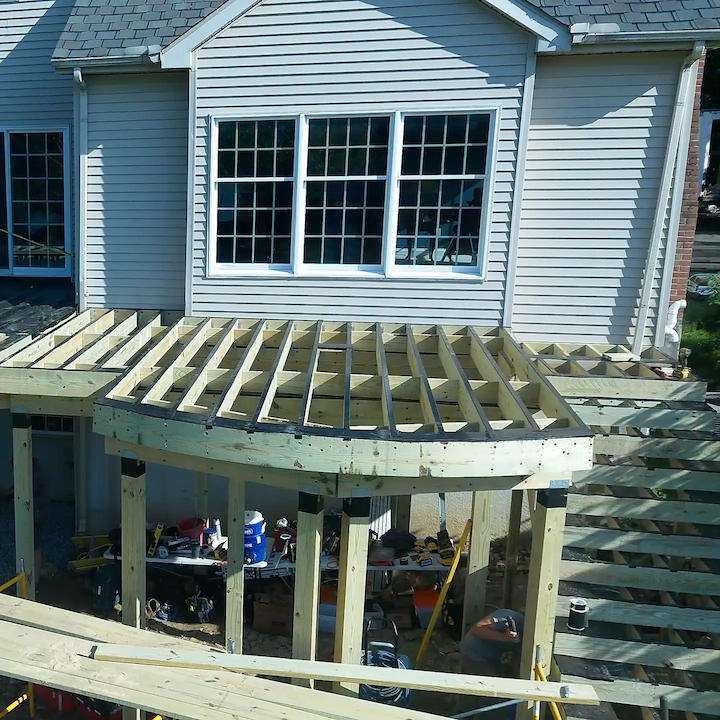
The deck in Bartlett looked solid from above. Boards tight, no visible rot, freshly power-washed for the listing photos. The seller had stained it before the sign went up.
Underneath told a different story. Joist hangers rusted through. The ledger board pulling away from the house. Posts sitting on bare dirt instead of concrete footings.
The surface told nothing about what was holding it up.
Deck construction in Memphis runs $14 to $43 per square foot depending on material. A typical 400 square foot deck costs $5,700 to $17,300. But the real cost depends on what's underneath, how high it sits, and whether the work needs a permit.
The Framing
A homeowner in Germantown called a contractor about her composite deck. Four years old, and something felt wrong.
"It bounces," she said. "Not a little flex. Actual bounce. I had six people out there for my daughter's birthday and I kept thinking about the weight."
He went underneath with a flashlight and a tape measure. Pressed his palm flat against a joist and pushed. It gave. He measured the gap between joists, then came back up and set the tape measure on the railing.
"Your joists are spaced 24 inches apart," he said. "Composite needs 16."
"I paid $12,000 for this deck." She stared at the boards. "Four years ago."
"The boards are fine. The material's heavier than solid wood and it doesn't have the same rigidity." He wiped his hands on his jeans. "Your rim joist has separated from the ledger too. And two posts sunk where the footings cracked."
She looked down at the surface. "So I'm not replacing the whole thing?"
"Just everything underneath it."
Joists carry load to beams. Beams transfer weight to posts. Posts sit on footings that anchor everything to the ground. Memphis humidity accelerates rust on hardware and rot on untreated lumber, and none of it is visible from the top.
Replacing framing costs $8 to $12 per square foot before new decking goes on. A deck needing new boards but sound framing is a $4,000 job. The same deck with compromised structure is $8,000. The framing is the same regardless of what sits on top of it. The boards are where the material choice shows up in the budget.
The Wood
A homeowner in Cordova sat across from her contractor with a simple plan. Sell in two years. Spend as little as possible.
"What's the cheapest deck you can build me?" she asked. "Four hundred square feet. Nothing fancy."
He pulled a sample board from his truck. Pressure-treated pine, still damp from the treatment plant. He pressed his thumbnail into the end grain and it left a dent.
"See that?" He held it up. "That's how soft it is fresh. Memphis heat dries it out by July. These boards cup and crack once the moisture leaves."
"How much?"
"Fifty-seven hundred. It'll look good the day I finish." He set the board down. "Ask me what it looks like in eighteen months."
She didn't ask.
He told her anyway. "Gray. Cupped boards. Splinters on the high-traffic areas. You'll need a $600 staining job before you list."
"So the $5,700 deck is really $6,300."
"If you keep up with it. If you don't, the buyer's inspector writes it up and you're negotiating a credit that costs more than the stain."
She looked at the sample board. The thumbnail dent was still there.
"And that's the cheapest option."
"That's the cheapest option that holds up long enough to sell."
Pressure-treated is the most affordable at $14 to $19 per square foot. A 400 square foot ground-level deck runs $5,700 to $7,700. The treatment resists rot and termites but doesn't prevent weathering. Without annual sealing and periodic staining, the wood grays, cracks, and splinters within a few years. The savings look different at the end than at the start, and that math is exactly what pushes most Memphis homeowners toward a material that eliminates the cycle entirely.
The Math
An East Memphis homeowner had been staining her pressure-treated deck for twelve years. She called a contractor after the sixth round.
"I've spent almost $5,000 maintaining a deck that cost $5,700 to build," she said. "I'm done."
"You want composite."
"I want something I never have to stain again."
He set two sample boards on her railing. One composite, one pressure-treated weathered gray from her own deck. He poured water from his bottle across both. The water beaded on the composite and soaked into the wood in seconds.
"That's twelve years of your weekends in two seconds," he said. "The wood absorbs. The composite doesn't."
She ran her hand across the composite sample. "How much?"
"Twenty-five to thirty-four a square foot installed. Trex, TimberTech, that range. Your size, about $10,200 to $13,800 for a 400 square foot deck. No rot, no splinters, holds its color."
She did the math. "So on the low end, I've already spent more than that in wood and stain."
"And it'll still look like this." He tapped the composite sample. "Not like that." He tapped her railing.
"What's the catch?"
"Scratches." He pulled a key from his pocket and dragged it across the corner of the sample. A white line appeared. "Heavy furniture leaves marks. Dropped grills dent the surface. You can't sand them out. They're permanent unless you replace the board."
She looked at the scratch, then at her stain-soaked deck. "No staining."
"No staining. No sealing. No annual anything."
"Build it."
And she could stop buying stain.
Composite costs $25 to $34 per square foot installed. A 400 square foot deck runs $10,200 to $13,800. The material resists rot, doesn't splinter, and holds color without maintenance. The trade-off is surface durability. Scratches don't sand out. They stay until the board gets replaced. But material is only half the equation. Two identical decks in the same composite boards can differ by thousands depending on how far off the ground they sit.
The Height
Two homeowners in Collierville wanted identical 400 square foot decks. Same composite material, same railings. The contractor quoted both jobs the same week.
He walked the first homeowner's yard. Flat lot, walkout basement, the deck would sit two feet off the ground. He crouched down, checked the grade with a level, and stood up.
"Twelve thousand," he said.
The second homeowner's yard sloped eight feet from the house to the tree line. The contractor stood at the back door, dropped a plumb bob off the edge, and watched the string hang free in the air below.
"Sixteen thousand," he said.
The homeowner looked at the string still swaying. "Same deck. Same material. Same railings. Why is mine four thousand more?"
"Yours is in the air." The contractor pointed down the slope. "Your posts are 12 feet tall instead of 4. Footings go 4 feet deep instead of 2. Every piece of lumber goes up a ladder instead of getting handed across at waist height. And code requires a staircase to grade at this elevation. That's another thousand before the first tread goes down."
"A week at ground level becomes what?"
"Two weeks. Maybe more if we get rain while the framing's exposed."
"So I'm paying for gravity."
"You're paying for everything gravity makes harder."
Elevation adds 30 to 35 percent to deck costs. A 400 square foot composite deck with railing runs around $12,000 at ground level. The same deck at 8 feet of elevation with stairs runs $16,000. Taller posts, deeper footings, more hardware, and slower work. Same boards, same railings, and the quote changes by thousands. Every foot of height also means closer scrutiny from the county. Elevated decks trigger permit requirements that ground-level builds sometimes avoid.
The Permit
A homeowner in Bartlett built a deck without pulling a permit in 2019. Four years later, the buyer's attorney checked county records and found nothing on file.
The contractor the homeowner called crouched at the ledger connection and wrapped his hand around a lag bolt. He turned it. It spun freely.
"This should take a socket wrench," he said. He held up the bolt. Half the threads were stripped. "It never bit into the framing. It was just sitting in the hole."
The homeowner watched from the doorway. "I hired a guy off Facebook Marketplace."
"I can tell." The contractor pushed the ledger board with his palm. It shifted half an inch away from the house. "Retroactive permit means a county inspector comes out here. He's going to ask me to open this wall so he can see what's behind the flashing."
"How much is that?"
"The permit's $200. Opening the wall, fixing the ledger, passing inspection -- that's a $4,500 conversation."
The homeowner's jaw tightened. "The buyer wants a $6,000 credit if I don't fix it."
"Then you're saving $1,500 by doing it right. But only if the structure passes inspection once it's open." He looked at the ledger again. "And right now, it won't."
Two hundred dollars in permits would have closed that sale without a conversation.
Shelby County requires permits for most decks. Attached decks need permits because the ledger affects house structure. Freestanding decks need permits if over 30 inches high or larger than 200 square feet. Permits cost $150 to $300.
Inspectors check ledger bolt spacing, joist hanger installation, footing depth, and railing height. A failed inspection costs $75 to $150 for a reinspection fee plus whatever labor to correct the deficiency. Most deck failures that show up years later trace back to connections that were never inspected. And inspection only catches what the installer already knew to get right.
The Contractor Question
I watched a couple in Lakeland do everything right last summer. Three quotes. Three companies with websites and five-star reviews. Professional trucks. Salesmen who said all the right things about materials and timelines.
They still had no way to know.
No way to tell which crew would answer the phone in January. No way to know if the installer actually carried workers comp or just said he did. No way to verify a license number they wouldn't think to ask for.
That's the gap this platform exists to close.
The deck contractor connected through here holds an active Tennessee Board for Licensing Contractors license with a monetary limit of $25,000 or higher. They carry $100,000 in general liability insurance and workers compensation for every crew member on the site. Their references were called, not collected. Their license was verified directly with the state. They were vetted in person by someone with more than two decades in Memphis construction.
That's the part that doesn't show up in a Google search.
Most estimator sites work by collecting your contact information and selling it to three to five contractors who then compete for your business with aggressive follow-up calls. This platform works differently. When you request a contractor introduction, we match you with one deck builder whose licensing, insurance, and work history have already been verified. One contractor, one homeowner, one conversation. No bidding wars and no phone spam.
The estimator itself requires nothing from you. No account creation, no email address, no phone number. Run as many estimates as you want, adjust the materials, compare pressure-treated against composite -- all of it happens in your browser using current Memphis pricing data. Your information stays yours until you decide otherwise. The only time we ask for contact details is when you choose to connect with a verified contractor for a formal bid.
Deck projects connect to backyard improvements. New decks pair naturally with fencing for defined outdoor living, and concrete patios anchor the space. Deck staining is often part of exterior painting projects. Pool surrounds often include deck space -- see the pool construction estimator. Ledger board connections to the house sometimes reveal siding damage. When a deck collapses due to improper ledger attachment or a contractor builds without the required permit, a construction attorney can assess liability for the structural failure and any resulting injuries.