The $10k Difference Wasn't the Siding
Two quotes for the same vinyl siding job on a two-story colonial in Collierville last fall. One came in at $15,000. The other at $25,000. Both estimates sat on the kitchen table for a week before anyone picked up the phone.
The difference wasn't the siding. It was what one contractor found when he looked behind it.
Siding replacement in Memphis runs $6 to $14 per square foot depending on material, home size, and what the old siding was hiding. A typical 1,800 square foot house costs $10,500 to $25,000 before sheathing repairs enter the picture.
The Sheathing
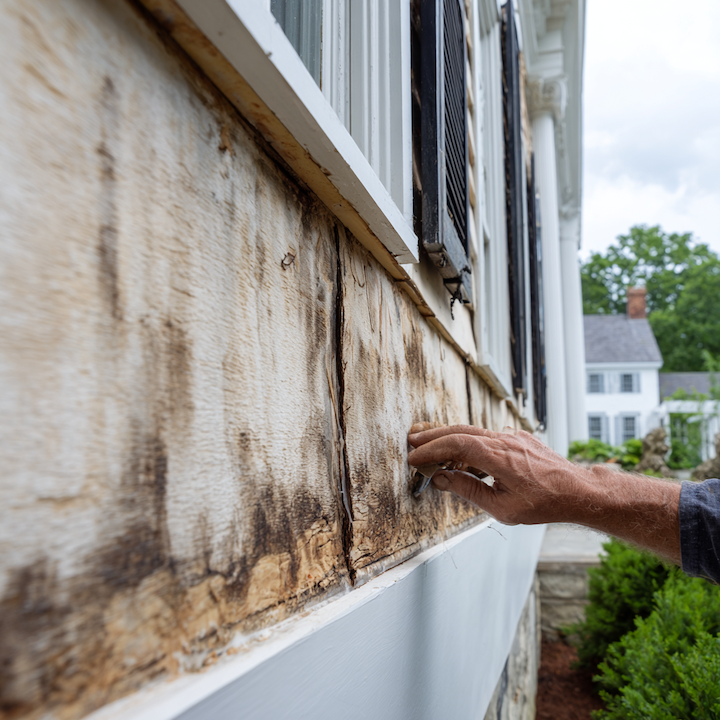
The crew pulled the first row of vinyl off a ranch in Bartlett and stopped. Behind it, the OSB sheathing had turned black.
"How long has this been going on?" the homeowner asked. She was already doing math in her head.
The contractor crouched at the sill plate and pressed his thumb against the sheathing. It sank in to the knuckle. He pulled his hand back and held it up. Wet.
"This is coming from your window flashing," he said. "Water's been running behind the siding every time it rains. The siding itself did its job. Everything behind it didn't."
"I had three guys out last year. Nobody mentioned flashing."
"They were looking at the siding. Not at what's under it." He stood up and ran his hand along the next section. Dry. Solid. "This is the part that makes two quotes for the same house look like different jobs. Sheathing replacement runs $3 to $5 a square foot. Re-flashing each window opening is $150 to $300."
"What does that mean for my number?"
"On a house with this much hidden damage, you're looking at 30 to 50 percent on top of the siding cost."
Sheathing damage from failed flashing can add 30 to 50 percent to a Memphis siding replacement. Replacement runs $3 to $5 per square foot, with window re-flashing at $150 to $300 per opening.
The homeowner stood in her yard for a long time after the crew left. The siding had looked fine from outside for years.
But siding that looks fine doesn't always mean the walls behind it are dry. And when the damage is localized to one area, tearing everything off isn't always the answer.
The West Wall
A tree limb went through the west wall of a house in East Memphis during a summer storm. The homeowner had already called her insurance company twice before the contractor arrived.
"I'm looking at re-siding the whole house, aren't I?" she said. It wasn't a question. She'd already decided.
The contractor walked the perimeter. He ran his hand along the south wall, checked the corners, crouched at the foundation line on the east side. Then he came back.
"You don't need all four sides," he said. "The damage is this wall and about two feet of the corner wrap. I found a salvage supplier with matching panels."
"From 2006? They'll match?"
"Close enough that you won't see it from 10 feet." He pointed to the intact walls. "Partial repair makes sense when the damage is localized. You're looking at 15 to 35 percent of what full replacement would cost."
"So what's the number?"
"About $4,500 instead of $15,000."
She looked at the tree limb still resting against her gutters. "I canceled my vacation over this."
"You can un-cancel it," he said.
Partial siding repair costs 15 to 35 percent of full replacement when damage is localized. A vinyl partial repair on a medium-sized Memphis home runs $4,000 to $5,600.
She called her insurance adjuster back that afternoon. The salvage match held. From the curb, you'd never know. But she still drove past the neighbor's house every morning -- the one where the south-facing vinyl had faded to chalk while the north side still looked new.
The Fade
A woman in Cordova pointed across her street at the house directly opposite hers.
"Same builder, same year, same vinyl," she said. "1998. Look at theirs and look at mine."
The contractor walked to the curb. The neighbor's south-facing wall had faded to a chalky gray. Hers still held its color.
He pulled a sample piece from his truck and held it next to her existing panels. The difference in thickness was visible without measuring.
"Dark colors and direct sun," he said. "That's the combination that kills vinyl. The UV breaks down the resin. Lighter colors reflect more heat and hold up longer."
"I picked dark blue because I liked it," she said. "Nobody told me it would look like this in 25 years."
"It lasted 25 years. That's not a failure." He set the sample against the faded neighbor's wall. "Vinyl runs $6 to $8 a square foot installed. It won't rot. You'll never paint it. But the color life depends on the exposure and the resin quality."
"So if I go dark again I'm doing this again in 15 years?"
"If you go dark on the south wall, yes. Lighter color on that elevation, dark on the north and east, and you get the look you want without the fade."
Vinyl siding costs $6 to $8 per square foot installed in Memphis. It won't rot and never needs painting, but dark colors on south-facing walls fade faster in Memphis's direct sun.
Every house on that street was the same age. You could tell which ones faced south. Vinyl was the most affordable option on the street, but it wasn't the only material that could handle Memphis weather without rotting. The house two doors down had something silver.
The Metal
The aluminum siding on a split-level in Whitehaven had been there since 1979. The homeowner's father had installed it. The homeowner's son was now asking about replacing it.
"Dad put this on before I was born," he said. "It still doesn't leak."
The contractor knocked on a panel with his knuckle. Solid ring. No give. He checked behind the J-channel at a window and found dry sheathing.
"Your dad made a good call," the contractor said. "Aluminum doesn't rot, doesn't burn, and it won't fade like vinyl does on a south wall. Forty-five years and the sheathing is still dry."
"So why doesn't everybody use it?"
The contractor pointed to a section near the driveway. Two dents from a weed trimmer. One deeper one from what looked like a baseball.
"It dents," he said. "That's the trade-off. Aluminum runs $7 to $10 a square foot installed. Won't fade, won't rot, handles Memphis humidity without any maintenance. But anything that hits it leaves a mark."
"Can you fix the dents?"
"I can replace those three panels for a few hundred dollars. The rest of this has another 20 years in it."
The homeowner ran his hand along the same panel his father had nailed up. No rot. No fade. Just dents from a life lived around it.
Aluminum siding costs $7 to $10 per square foot installed in Memphis. It resists rot, fire, and UV fading but dents on impact. A well-installed aluminum job can last 40 years or more with minimal maintenance.
Aluminum wouldn't dent if nobody touched it. But a house where kids play and branches fall and mowers throw rocks isn't a museum. For the homeowner who wanted the look of wood without the repainting, there were other options.
Twelve Coats
The wood siding on a 1920s bungalow in Midtown had been painted twelve times. A contractor crouched near the foundation line, scraping with a five-in-one tool. Three layers came off in a single curl.
"Three days just to get down to bare wood," he said. "That's before we prime and paint."
"Is it worth keeping?" the homeowner asked. She'd already gotten two quotes to tear it off.
"Depends on what's under it." He pressed the blade into a section near the corner. Solid. He moved to the area beneath a bedroom window. The wood gave. "See that? Water's been sitting here every time it rains. The rest is sound."
"How much to replace the whole house in new wood?"
"Wood siding runs $9 to $13 a square foot to install new. And you're repainting every 5 to 7 years in Memphis. This humidity eats paint." He wiped his hands on his jeans. "If you want the look without the maintenance cycle, engineered wood like LP SmartSide gives you that. $8 to $11 a square foot, better rot resistance, and a 50-year warranty from the manufacturer."
She looked at the paint curls on the ground. "So I'd be done repainting?"
"You'd be done repainting."
"What about all this?" She gestured at the hundred-year-old clapboard.
"This is original heart pine," he said. He ran his palm flat along a section where the grain still showed through the paint. "I wouldn't tear it off. I'd scrape it, prime it, and paint it one more time. You've got 80 years of character in these boards. The section under the window gets replaced. Everything else gets saved."
Wood siding runs $9 to $13 per square foot installed in Memphis and requires repainting every 5 to 7 years. Engineered wood alternatives like LP SmartSide cost $8 to $11 with better rot resistance and a 50-year manufacturer warranty.
She hired him to scrape and repaint. The original heart pine stayed. But the conversation she kept thinking about was the one number: every 5 to 7 years. Multiply that over a 30-year mortgage and the cheapest siding on the wall isn't the cheapest siding you'll own. The house down the street with the fiber cement hadn't been touched in 15 years.
Fifteen Years
A homeowner in Germantown walked his contractor around the side of the house.
"James Hardie," he said. "Fifteen years."
The contractor ran his hand along the panels. The color had barely shifted. No warping. No cracks. He crouched at the foundation line and checked the gap between the siding and the concrete. Consistent. No settling, no buckling.
"This is why fiber cement costs more upfront," the contractor said. "$10 to $14 a square foot installed. But the paint holds 15 to 20 years. Class A fire rating. And it handles Memphis humidity like it was made for it."
"My neighbor spent $11,000 on vinyl three years ago," the homeowner said. "I spent $20,000 on this. He's already got fade on the south side."
"Vinyl is a good product for the right situation," the contractor said. "But fiber cement doesn't care which direction the wall faces."
"Would you put vinyl on your own house?" the homeowner asked.
"I'd put vinyl on a rental," the contractor said. "I'd put Hardie on the house where I'm raising my kids."
Fiber cement siding costs $10 to $14 per square foot installed in Memphis and holds paint for 15 to 20 years. It carries a Class A fire rating and resists the humidity and temperature swings common in the Mid-South.
The Hardie held. The installation was sound. The only variable left in a siding job this size -- $18,000 to $25,000 on a medium home in Germantown -- was the person who installed it.
The Contractor Question
The homeowner in Collierville called both contractors back. She asked the $15,000 bidder to show her where he'd checked the sheathing. He hadn't.
She went with the higher quote. Not because it was higher, but because the contractor who wrote it had actually looked at what was behind her walls.
Siding replacement in Memphis runs $6 to $14 per square foot depending on material. A typical 1,800 square foot house costs $10,500 to $25,000. But the real cost depends on what someone's willing to find before they cover it back up.
She did everything right. She got multiple quotes, compared materials, asked about sheathing. The one thing she couldn't verify on her own was whether the contractor standing in her yard had the license, the insurance, and the track record to back up what he quoted.
She couldn't verify that part from a website.
The contractors connected through this platform carry an active Tennessee Board for Licensing Contractors license with a monetary limit of $25,000 or higher, $100,000 in general liability insurance, and workers' compensation for every crew member. Their references were called, not collected. Their licenses were verified directly with the state. Each one was vetted in person by someone with more than two decades in Memphis construction.
None of that shows up in a Google search.
Siding projects often connect to other exterior work. If the fascia and soffits show damage, the gutter estimator covers those repairs. New siding pairs naturally with exterior painting. If the damage came from a roofing failure, the roofing estimator can scope that work too. Replacing siding is the ideal time to upgrade windows before new trim goes on, and adding house wrap and insulation behind new boards improves energy performance. When a storm damage claim gets denied or an insurer argues the damage was pre-existing wear, a construction attorney can review the denial and the policy language before appeal deadlines pass.