The $800 Gap Behind the Aluminum
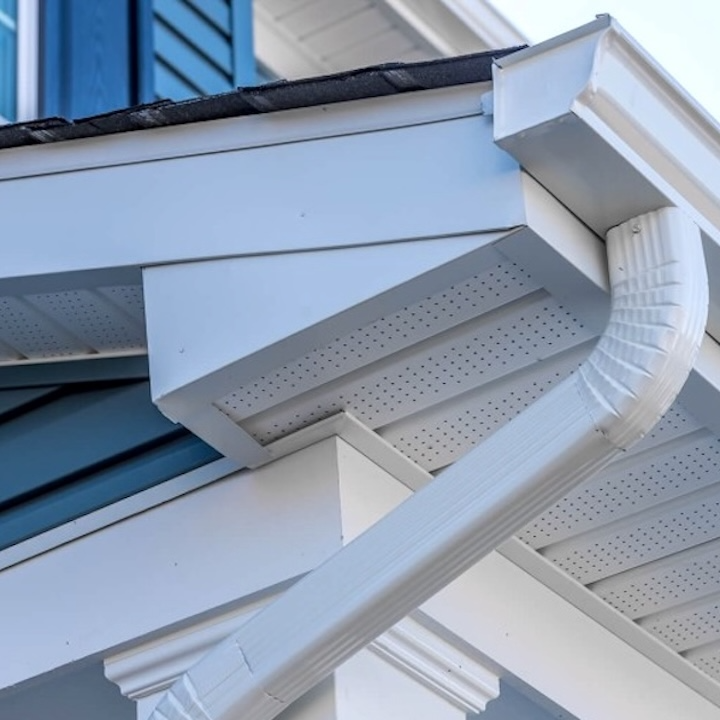
Two quotes sit on a kitchen counter in Collierville. Same ranch house. Same seamless aluminum. Same 200 linear feet of roofline. One comes in at $2,100. The other at $2,900.
Gutter installation in Memphis runs $8 to $12 per linear foot for standard seamless aluminum, $9 to $15 for steel, and $21 to $33 for copper. A typical 3 to 4 bedroom home with 200 linear feet of gutter costs $1,600 to $2,400 in aluminum before add-ons like guards, removal, or multi-story access. The range stretches from there. But the widest gap on any gutter job is usually not the material. It is what the quote does or does not include behind the aluminum.
The Fascia
A section of gutter had pulled away from a house in Bartlett the previous fall. The aluminum looked fine. The contractor pressed his thumb against the fascia board where the hangers were supposed to anchor. It went right through.
"I've had two guys come look at this," the homeowner said. "Both of them wanted to rehang the gutter. Nobody touched the wood."
"That's because the gutter wasn't the problem." He pulled a section of fascia away with his hand. Soft, dark, crumbling. "This has been rotting from behind for years. Gutters overflow in heavy rain, water backs up and sits against the fascia, and the paint hides it until the hangers lose their grip."
She stared at the exposed sheathing. "So the $350 I spent on someone rehanging it last spring was for nothing."
"It held for a few months. It was always going to pull away again." He ran his hand along the next 10 feet of fascia, pressing every few inches. Solid, solid, solid, then his thumb sank in again. "You've got about 40 feet that needs replacing. Fascia runs $8 to $15 per linear foot. That's $400 to $750 before the new gutters go up."
He held up the piece he'd pulled free. The back side was black and soft, like wet cardboard.
"And if I just hang new gutters over it?"
"New aluminum over rotted wood pulls away within a few years. You'll be standing here again having this same conversation."
She looked at the section he'd pulled away. "So the gutters didn't fail."
"The gutters were fine. The wood behind them was gone."
Soft fascia behind old gutters is the most common hidden cost on a gutter job. Replacing 30 to 50 feet of damaged fascia adds $400 to $750 to a project. But fascia rot only happens when water gets behind the aluminum -- and the most common reason water gets behind the aluminum is a system that can't handle the volume coming off the roof.
Size and Slope
Brand-new gutters on a house in Cordova. First May thunderstorm, water poured over the front edge like they weren't there.
"I paid $2,000 for these three months ago," the homeowner said. "Three months. And they're already overflowing."
The contractor climbed a ladder and held a level across the gutter run. Pitch was fine. He looked up at the roofline. Two steep planes converged into a single valley that fed one 20-foot gutter section.
"Your gutters aren't failing," he said. "They're undersized. You've got a steep pitch and two roof planes dumping into the same run. That's a lot of water hitting a small channel at once."
"The installer never said anything about that."
"Standard 5-inch handles most Memphis homes. Yours needed 6-inch on this section." He pointed where the two planes met. "Memphis gets about 54 inches of rain a year. On a roof this steep, the water moves fast. Five-inch can't catch it."
"So I need to rip these out and start over?"
"Just this section. The rest of the house is fine with 5-inch." He measured the run with a tape. "About 40 feet. The upgrade from 5-inch to 6-inch adds $1 to $2 per linear foot. On 150 feet, that's $150 to $300. On your 40 feet, it's $40 to $80 to solve this."
She looked at the water stain already forming on the fascia below the overflow point. "And that $2,000 I already spent?"
"The other 200 feet of gutter are doing exactly what they should. This one section just needed a bigger channel. It's an $80 fix, not a $2,000 mistake."
Standard 5-inch gutters handle most Memphis rooflines. Steep pitches or large collection areas need 6-inch, adding $1 to $2 per linear foot. The volume problem is solved once the gutters are sized to the roof. The next question is what happens when something other than water gets into them.
Gutter Guards
An East Memphis homeowner climbed a ladder for the first time in three years. She pulled back the gutter guard and looked underneath.
"There's sludge in here," she said. "I paid $1,400 to never have to do this again."
"That's the most common misunderstanding with guards," the contractor said. He climbed up beside her and tilted the guard panel forward. Dark paste lined the bottom of the channel. "Screen guards block leaves and large debris. But small particles get through. Oak pollen, pine needles, shingle grit. It decomposes into this."
"So I wasted $1,400."
"No. Three years ago this would have been packed solid without them. Guards turned a twice-a-year chore into an every-few-years chore. They reduced the problem. They didn't eliminate it."
"What about the micro-mesh ones everyone's advertising now?"
"They catch almost everything." He scraped the top of the existing guard with his thumbnail. "But shingle grit builds up on top and blocks water from entering. You trade debris inside the gutter for debris on top of the guard." He lifted the panel all the way off and held it up. "For homes with mature hardwoods like yours, guards still make sense. You're just up here every 3 years instead of every 6 months."
She looked at the row of oaks lining her yard. "What do guards actually cost these days?"
"$6 to $8 per linear foot installed, depending on the type. On your house, about 200 feet, that's $1,200 to $1,600 on top of the gutter installation itself."
"And if I skip them?"
"You're back on this ladder twice a year. Your choice. Just don't let anyone tell you guards mean never."
Gutter guards add $6 to $8 per linear foot to an installation, adding $1,200 to $1,600 on a typical Memphis home. They reduce cleaning frequency but don't eliminate it. Homes with mature trees benefit most, though maintenance every 2 to 3 years is still necessary. Even with guards, though, every gallon of water the system collects still has to go somewhere -- and where it goes matters more than most homeowners realize.
Downspouts
A foundation crack in a Germantown home traced back to one spot. The contractor crouched next to the downspout and held a tape measure from the discharge to the foundation wall.
"Two inches," he said. He stood up and pointed at the crack running diagonally above. "Every storm, hundreds of gallons concentrate right here. The clay soil swells, pushes the wall, and you get that."
The homeowner stared at the crack. "We just spent $4,000 on foundation repair. You're telling me a downspout did this?"
"Memphis clay doesn't drain. Water sits against the foundation, the soil expands, and over time it pushes the wall in. Extensions should carry water at least 4 feet out. Yours is dumping it 2 inches away."
"Nobody mentioned the downspouts during the foundation work."
"That's the part that gets missed. They fixed the symptom. The cause is still sitting right here." He walked the perimeter of the house, checking each downspout. Three more were discharging within a foot of the foundation. "Underground drain lines cost $200 to $500 per downspout, but they move water 10 to 20 feet away. On your four problem spots, that's $800 to $2,000. Cheaper than another foundation repair."
Water from the night before still pooled at the base of the nearest downspout, dark and still against the brick.
She did the math in her head. "$4,000 we already spent. And this was the cause the whole time?"
"I can't say for certain it was the only cause. But it was the obvious one." He kicked the splash block that had shifted out of position. "Most people look up at the gutters. The real question is where the water goes when it comes back down."
Downspout extensions should carry water at least 4 feet from the foundation. Underground drain lines cost $200 to $500 per downspout but move water 10 to 20 feet away. Memphis clay soil makes proper drainage critical. When the gutters, the downspouts, and the drainage all need attention at once, the question shifts from what to install to what's worth keeping and what needs to go.
Repair or Replace
A seller in Midtown wanted to replace all 200 feet of gutters before listing. The system was 22 years old and looked tired.
The contractor walked the perimeter with her. He pulled on each section as he went. Most held firm. He stopped at a corner where a gutter had separated from the downspout and water staining ran down the siding.
"You've got about 35 feet that needs work," he said. "The rest is solid."
"It all looks terrible," she said. "I can't list the house with gutters that look like this."
"It looks old. There's a difference." He gripped a section and pulled hard. It didn't move. "These hangers are fine. The seams are tight. You'd be paying to replace gutters that have another 10 years in them."
"What does it cost either way?"
"Full replacement on 200 feet of aluminum with removal of the old system runs about $2,500. Targeted repairs on the 35 feet that actually need it, about $650." He pointed to the separated corner. "Hanger replacement runs $2 to $4 per hanger. Section replacement runs $6 to $15 per linear foot. We fix what's broken and leave what's working."
"If I'm selling the house, does a buyer care whether I repaired or replaced?"
"A buyer cares that the gutters work. An inspector checks for proper drainage, secure attachment, no leaks. They don't check for age." He ran his hand along the seam of a section he'd already tested. "This is tight. A new gutter won't be any tighter."
She looked at the corner with the separation. "So $650 instead of $2,500."
"Fix the 35 feet. Clean the whole system. It'll inspect fine and you keep $1,850 in your pocket."
Full gutter replacement on a typical Memphis home runs $1,600 to $2,400 for standard aluminum. Targeted repairs cost a fraction when damage is limited to specific sections. But whether the job is a full replacement or a targeted repair, the part that determines whether it lasts is not the aluminum. It's the contractor who hangs it.
The Contractor Question
The homeowner in Collierville stood in his driveway with two quotes in hand. The $2,100 bid planned to hang new aluminum over the existing fascia -- no inspection, no testing, just screws into whatever wood was behind the old gutters. The $2,900 bid included checking every foot of fascia and replacing the 40 feet that had gone soft. One system would last 20 years. The other would be sagging again within 3.
He picked the lower number. Most people do. Nothing in either quote explained what was behind the gutters or why it mattered.
Every contractor connected through this platform carries an active Tennessee Board for Licensing Contractors license with a monetary limit of $25,000 or higher, $100,000 in general liability insurance, and workers compensation for every crew member. References are called, not collected. Licenses are verified directly with the state. Every contractor is vetted in person by someone with more than two decades in Memphis construction.
Most estimator sites collect contact information and sell it to three to five contractors who then compete with aggressive follow-up calls. This platform works differently. One gutter installer, matched to the project scope, whose licensing, insurance, and work history have already been verified. One contractor, one homeowner, one conversation. No bidding wars and no phone spam.
The estimator itself requires no account creation, no email address, no phone number. Homeowners can run as many estimates as they want, adjust the linear footage, compare aluminum against copper against zinc -- all of it happens in the browser using current Memphis pricing data. Contact details are only shared when a homeowner chooses to connect with a verified contractor for a formal bid.
Gutter work connects to the building envelope. New gutters often follow roof replacement, and proper drainage prevents foundation problems down the line. Fascia repairs sometimes reveal siding issues that need attention. Poor drainage leads to waterproofing needs in basements and crawlspaces, and fascia and soffit work pairs naturally with exterior painting. When water damage from failed gutters triggers an insurance dispute or a contractor installs a system that directs runoff into a neighbor's property, a construction attorney can sort out liability before the damage compounds.
Gutter installation in Memphis runs $8 to $12 per linear foot for standard seamless aluminum. The real cost depends on what's behind them.