The Walls Keep a Record of Every Rain
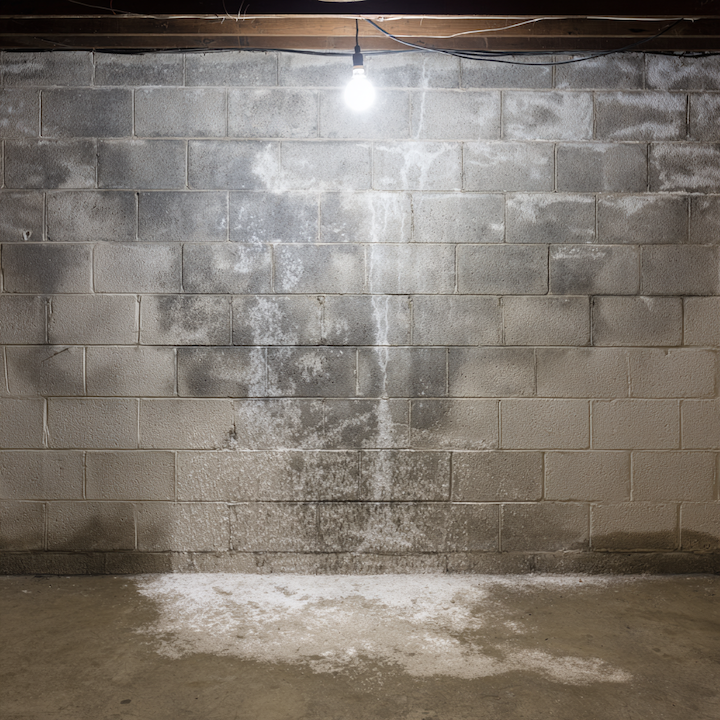
The East Memphis basement had white mineral deposits creeping up the block walls like chalk dust. Efflorescence. The concrete was wicking moisture from saturated clay on the other side, leaving a map of every rain event from the past two years. Waterproofing runs $2,000 to $48,000 in Memphis depending on the source of the water, the method required to stop it, and how long the problem has been ignored.
Where the Water Comes From
A Cordova crawlspace had two inches of standing water when the homeowner pulled back the access panel. She had been smelling something damp for months and assumed the worst.
"I've been putting off looking under here for a year," she said. "Please tell me it's not the water table."
The contractor lowered himself through the access and pressed his palm flat against the foundation wall at the base. He held it there for a few seconds, then pulled it back and showed her his hand. Wet.
"Feel that?" he said. "It's coming through the wall, not up from the ground. You've got surface water pooling against the foundation outside and finding the cold joint where the footing meets the stem wall."
"So it's not as bad as I thought?"
"It's not what you thought. Whether it's bad depends on how long it's been sitting here."
Memphis gets 54 inches of rain annually. Yazoo clay soil expands when wet and holds that water against foundations for weeks. The fix depends entirely on the source. Surface water is a grading and gutter problem. Subsurface water requires drainage systems. Ground moisture calls for vapor barriers. A contractor who skips the diagnostic and jumps straight to a solution is guessing with someone else's money. When the source is subsurface pressure pushing water through the foundation, the most common first response is managing it from inside.
Interior Drainage
A Bartlett homeowner pointed to dark stains running along the floor-wall joint in her basement. The line was continuous, tracing the entire east wall.
"I've spent $400 on sealant and caulk in the last two years," she said. "Every time I think I've got it, the next big rain puts me right back where I started."
The contractor knelt at the joint and pressed his thumb against the seam. A bead of water squeezed out around his finger.
"That's hydrostatic pressure," he said. "The water table rises after a rain, pushes against the bottom of the slab, and finds this joint. You could caulk it every week. The pressure will find the next weak spot every time."
He walked the perimeter and marked three low spots in the floor with chalk.
"Interior drainage accepts that water will get in and manages it before it becomes your problem. We cut a trench along the perimeter, lay drain tile, and route everything to a sump pit."
"Wait -- the fix is to let the water in on purpose?"
"It comes in below the slab where you never see it, hits the drain, and gets pumped out. The floor goes back over the top. You'd never know it was there."
She looked at the chalk marks and then back at the stained wall. "How much for just this east wall?"
"The drainage runs $100 a foot, so 60 feet is about $7,000. Add the pump at $2,500 and you're at $9,500 for this section. Full perimeter, 180 feet, that's $18,000 for drainage plus the pump."
"And I can stop buying caulk."
"You can stop buying caulk."
Interior perimeter drainage runs $95 to $150 per linear foot in Memphis. Most full-basement systems land between $6,000 and $23,000 depending on linear footage and access conditions. Interior drainage handles liquid water effectively. But not every water problem arrives as liquid.
The Bartlett homeowner's system came in at $8,200 for 65 linear feet. She hasn't touched sealant since.
Crawlspace Encapsulation
The Frayser crawlspace had no vapor barrier. Bare dirt, standing humidity at 87%, and floor joists dark with surface mold. The homeowner had noticed his hardwood floors buckling upstairs and called thinking he needed a flooring contractor.
"I just had those floors installed eight months ago," he said. "The installer said the subfloor looked fine."
The contractor pointed his flashlight at the joists directly below the buckling. Dark stains ran the full length. He held up a moisture meter and pressed it against the subfloor. The reading was 28%.
"Anything over 19% and wood starts to deform," he said. "Your floors aren't the problem. They're telling you what's happening underneath. Uncontrolled moisture is migrating up from the soil through the whole structure. The subfloor is swelling and your hardwood is moving with it."
"So the floors I just paid for are ruined?"
"They might recover once the moisture is controlled. Hardwood has some memory. But first we have to stop what's feeding it."
"What does that look like?"
"We seal this space from the ground and from outside air. Heavy-duty vapor barrier across the floor and up the walls, sealed at every seam. Vent covers closed and sealed. Then a commercial dehumidifier to maintain 55% or lower year-round." He tapped one of the discolored joists. "Once we control the moisture, the mold stops progressing and the subfloor starts drying."
The homeowner stared at the mold on the joists. "My kids play on that floor. Have we been breathing this?"
"Surface mold in a crawlspace doesn't automatically mean airborne exposure upstairs, but it means the conditions are right for it to get worse. That's why we treat before we seal. Antimicrobial application on every affected surface."
"Can't we just seal over it and trap it?"
"Encapsulation without remediation traps the problem inside a sealed space. The mold doesn't die just because you covered it. We treat first. Then we seal."
Full crawlspace encapsulation costs $7 to $12 per square foot in Memphis. A typical 1,200 square foot crawlspace runs $9,000 to $13,500 depending on vapor barrier grade, number of piers and supports to work around, and whether remediation is needed first. Homeowners routinely report energy bills dropping 15 to 20% after encapsulation because the HVAC system stops conditioning unchecked humid air from below.
The Frayser homeowner's encapsulation ran $10,800 for 1,200 square feet including remediation. Six months later, his moisture meter read 12%.
TVA's EnergyRight program offers rebates up to $500 for qualifying encapsulation work.
Encapsulation and interior drainage both manage moisture that's already inside the envelope. Neither stops water from reaching the foundation in the first place.
Exterior Waterproofing
A Germantown homeowner had waterproofed his basement three times from the inside. French drain, sump pump, wall sealant. Water still seeped through a horizontal crack four feet up the east wall after every heavy rain.
He had the invoices in a folder. Three different companies over four years.
"I've spent $14,000 on this wall," he said. "Someone needs to explain to me why it's still wet."
The contractor ran a straightedge across the crack. It wasn't random. It followed the mortar joint in a straight horizontal line -- a pressure fracture from the outside.
"The crack is on the positive side," he said. "Pressure side. No amount of interior work stops water that's being pushed through the wall under hydrostatic pressure at that height. The three contractors who worked in here were solving the wrong problem."
"So $14,000 just gone."
"The French drain and sump aren't wasted. They'll handle floor-line seepage for years. But your water is coming through the wall itself at four feet. That's exterior pressure. The only fix is to stop it from the outside."
Exterior waterproofing requires digging down to the footing, applying waterproof membrane to the foundation wall, and installing drain tile at the base to redirect water before it reaches the structure. The Germantown job required excavating 60 linear feet along two walls, working around a patio and established landscaping.
"We dig down to the footing, apply membrane, lay new drain tile, and backfill with drainage stone," the contractor said. "For your footage and site conditions, you're in the $12,500 to $18,500 range."
The homeowner looked at the folder of invoices on the table. "If someone had told me this four years ago, I'd have one bill instead of four."
Exterior waterproofing runs $200 to $300 per linear foot in Memphis. The wide range reflects excavation depth, soil conditions, landscaping restoration, and whether the existing drainage infrastructure can be reused. It is the most invasive method and the most effective for stopping water at its source. But every system -- interior or exterior -- still needs somewhere to send the water it collects.
The Germantown project ran $14,400 for 60 linear feet including backfill and landscaping restoration. Two years later, the crack hasn't shown moisture.
Sump Pumps and Backup Systems
The Midtown homeowner had a working sump pump. It ran every heavy rain like clockwork. Then a summer thunderstorm knocked power out for six hours and four inches of water covered the basement floor.
He was still pulling wet boxes out of the basement when the contractor arrived.
"I did everything right," he said. "I had the pump. I maintained it. Nobody told me I needed a backup."
The contractor opened the sump pit and ran the pump manually. It kicked on immediately, strong and clean.
"Pump's in great shape," he said. "It just didn't have electricity. That's not a pump failure. That's a system design problem."
"How much would it have cost to prevent this?"
"About $1,000. A battery backup system sits on a separate circuit. When shore power goes out, it takes over automatically. A good unit runs 8 to 12 hours on a full charge under normal cycling."
The homeowner looked at the waterline on the basement wall. Four inches of damage from a missing $1,000 component.
"Some of the newer units have a secondary pump on the battery circuit so the primary stays dedicated to shore power," the contractor said. "For your setup, I'd replace the primary and add a dedicated backup. $2,500 total. The primary alone would be $1,500, but I wouldn't install one without backup. Not in Midtown with these old utility lines."
Primary sump pumps run $1,200 to $1,800 installed in Memphis. Battery backup systems add $800 to $1,300 depending on pump capacity and battery technology. The equipment worked. The installation was sound. The only failure was a missing $1,000 battery backup that nobody recommended.
The Contractor Question
The homeowner in Germantown sat across from three waterproofing estimates spread on her kitchen table. Two recommended interior drainage. One recommended exterior excavation. The prices ranged from $6,000 to $18,000. None of them were wrong on paper. But only one contractor had gone into the crawlspace with a moisture meter and traced the water to a failed foundation joint on the south wall.
She went with that contractor. Not because he was cheapest or most expensive, but because he'd diagnosed the source before recommending the fix.
Waterproofing in Memphis runs $2,000 to $48,000 depending on the method and scope. Interior drainage, crawlspace encapsulation, exterior excavation -- each solves a different problem. But the real cost depends on whether someone correctly identified what the problem was before they started solving it.
She did everything right. She got multiple quotes, asked about drainage versus encapsulation, pushed back when answers didn't add up. The one thing she couldn't verify on her own was whether the contractor standing in her basement had the license, the insurance, and the track record to back up what he quoted.
Every waterproofing contractor connected through this platform carries:
An active Tennessee Board for Licensing Contractors license. A monetary limit of $25,000 or higher. $100,000 in general liability insurance. Workers' compensation for every crew member. References called, not collected. License verified directly with the state. Vetted in person by someone with more than two decades in Memphis construction.
Waterproofing connects to below-grade work. Moisture issues often accompany foundation problems. Proper gutter systems direct water away from the house. And once dry, many homeowners proceed with basement finishing. Plumbing leaks underground are a common source of moisture intrusion. Active flooding situations may need emergency restoration before waterproofing can begin.