Twenty-Seven Summers
Memphis HVAC replacement starts at $2,400 for a small home. Most replacements on existing ducts fall between $5,800 and $14,200. Premium whole-house systems with new ductwork can reach $33,600.
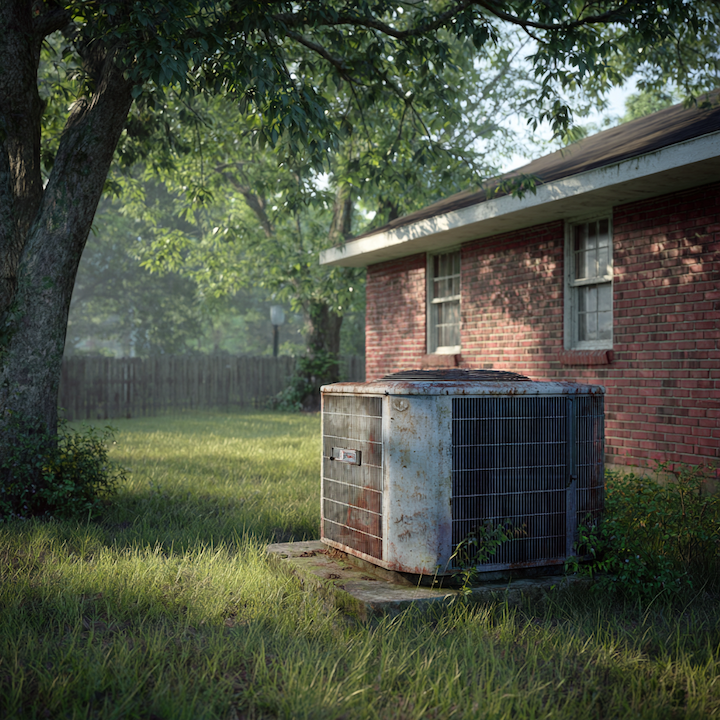
The compressor died on a Thursday in July. Gloria heard it from the kitchen. A grinding sound that lasted three seconds and then nothing. The house went quiet in a way that houses in Memphis are not supposed to go quiet in July.
By Friday morning the thermostat read 84. By Friday afternoon it read 91. James had opened every window, set up two box fans in the hallway, and pulled the window unit from the garage that they hadn't used since the ice storm in 2021.
Gloria was already on the phone. She called three companies before her shift at Baptist Memorial.
The first quoted $4,800 over the phone. Fourteen-SEER2 AC, builder-grade, swap on the existing pad. He didn't ask about the furnace.
The second quoted $14,500. Heat pump system, new duct runs in the attic, premium brand. He asked about square footage and nothing else.
James wrote both numbers on the back of an envelope and stared at them. "That's a $10,000 spread on the same house."
Gloria made the third call. Ray answered on the second ring.
"I can't quote you over the phone," he said. "I need to see the house."
"When?"
"Tomorrow morning. Seven thirty, before it gets hot."
She looked at James. He nodded.
"We'll be here," she said. "Our granddaughter arrives a week from Saturday. The house has to be cool by then."
Some systems don't fail. They just finish.
The Load Calculation
Ray pulled into the driveway at seven twenty-five in a white truck with no lettering on the side. No magnetic signs, no wrap, no slogan. James noticed.
He walked the house before he said anything. Started at the thermostat. Looked at the return vent in the hallway. Held his hand in front of the supply vent in the living room.
"Feel that," he said.
James put his hand where Ray's had been. Air from the window unit was pushing through the room, but the vent itself was dead.
"That's your system. Nothing coming out." Ray walked to the outdoor unit. The condenser sat on a concrete pad next to the house, surrounded by monkey grass that James kept trimmed. The unit was clean. James had cleaned it every spring for 27 years.
"You took care of it," Ray said. It wasn't a question.
"Changed the filter every month. Had it serviced twice a year. Washed the coils every April."
"That's why it lasted 27 years. Most systems in Memphis go 15 to 20." Ray pulled a clipboard from his bag. "But the compressor is done. No repair on this one."
He started asking questions nobody else had asked. Ceiling height. Insulation in the attic. Number of windows and which direction they faced. How many people lived in the house. Whether they kept the blinds closed on the west side in the afternoon.
"What does any of that have to do with replacing the AC?" James asked.
"Everything. Your current system is 5 tons. For 1,800 square feet with standard insulation and eight-foot ceilings, you need 3.5 tons." Ray wrote the number on his clipboard. "Whoever installed the original oversized it by a full ton and a half."
"Bigger cools faster, doesn't it?"
"Bigger short-cycles. Kicks on, drops the temperature fast, shuts off before it runs long enough to pull the humidity out of the air. That's why your house always felt clammy at 72. The system was too big to dehumidify."
James looked at the thermostat he'd read every morning for 27 years. "Nobody ever told me that."
"Nobody ran the calculation." Ray tapped the clipboard. "A proper load calculation takes into account ceiling height, insulation, window orientation, and local climate data. Memphis runs 30 to 40 BTU per square foot for cooling load. For this house, that's a 3 to 3.5 ton system. The calculation takes 30 to 60 minutes and should be free with any serious bid."
Gloria was watching from the doorway. "The first company quoted us without asking any of those questions."
"Then the number is a guess," Ray said. "And a guess runs for 15 years."
The system James maintained for 27 years was the wrong size the day it was installed. He never knew because nobody measured the house.
The Attic
Ray looked at the ceiling in the hallway. "I need to go up."
"It's July," James said. "It's going to be 130 degrees up there."
"I know." Ray pulled the attic access panel in the hallway closet and climbed through with a flashlight and a moisture meter.
James listened from below. He heard Ray moving across the joists, stopping, moving again. Three minutes passed.
"Come look at this," Ray called down. "Bring your phone."
James pulled himself up through the access panel. The heat hit him like opening an oven. He crawled toward the flashlight.
Ray was pointing at a flex duct run that had come loose from the boot connecting to the ceiling vent. Cooled air had been blowing into the attic insulation.
"How long has that been like that?" James asked.
"Could be years. Could be since the original install. Nobody sees it unless they come up here." Ray panned the flashlight down the run. A second section of flex duct was crushed flat where it crossed a truss. "That bedroom gets maybe half the airflow it should."
"That's Keisha's room." James stared at the crushed duct. "My granddaughter's room. Gloria always said that room ran warm."
"Now you know why." Ray checked three more connections. Two were intact. One had tape that had dried out and was starting to separate. "Your ductwork isn't destroyed. But it needs repair before a new system goes in."
"What does that cost?"
"Duct sealing runs $500 to $1,500 for reconnecting loose joints and sealing leaks. Full duct replacement runs $3,900 to $8,000 when the runs are crushed, undersized, or disconnected. Yours falls in between. The disconnected run and the crushed section need new flex. The rest needs sealing and new tape at the joints. I'd estimate $2,000 to $2,500 for this house."
James took a photo of the disconnected duct with his phone. "The company that quoted $4,800 -- they weren't going up here?"
"They quoted an AC swap on the pad. Equipment for equipment. If the ductwork leaks a third of the air before it reaches the rooms, the new system works just as hard as the old one."
They climbed back down. James looked at the photo on his phone.
"I've been cooling my attic for 27 years."
"Part of it. Memphis attics hit 140 to 150 degrees in July. Every degree your ductwork leaks costs money every month for the life of the system."
The equipment gets the sticker. The ductwork decides whether it works.
The Decision
Ray sat at the kitchen table with his clipboard and a calculator. Gloria had come home from her shift and changed out of scrubs. James had made coffee. It was nine in the morning and already 87 degrees in the house.
"You have three paths," Ray said. "I'm going to give you numbers on all three and let you decide."
Gloria pulled a notepad toward her. She wrote the same way she charted at the hospital. Neat columns, no wasted space.
"Path one. AC and furnace combo, standard efficiency, economy brand. Fourteen-point-three SEER2, 80% AFUE on the furnace. On your house with duct repair, that's $8,600 to $11,600. Lowest upfront cost. Meets current code. No rebates."
"Path two. AC and furnace combo, high efficiency, midrange brand. Sixteen SEER2, 92% AFUE furnace. With duct repair, $10,500 to $14,200. Lower monthly bills. Better humidity control. The higher SEER2 rating means the system runs longer at lower output instead of cycling on and off."
Gloria wrote both numbers. "What's the monthly difference?"
"On this house, roughly $60 to $90 per month in savings over a standard efficiency unit. Over 15 years, that's $10,800 to $16,200 in lower utility bills. The efficiency upgrade pays back about half to two-thirds of the price difference."
"Path three?"
"Heat pump. All electric, heats and cools from one outdoor unit. High efficiency, midrange brand, with your duct repair. $10,300 to $13,900. Similar upfront to path two, but TVA gives better rebates on heat pumps."
James looked at the three columns. "What about the brand? That first company quoted Goodman. The second quoted Trane."
"Goodman is economy tier. Solid equipment, best value. Rheem and York are midrange -- balanced price and quality. Carrier, Trane, and Lennox are premium. On this house, the brand difference between economy and premium adds $1,500 to $3,000 to the install. The warranty difference is usually two to five years."
Gloria tapped her pen on the notepad. "What about those mini-splits I keep seeing online?"
"Mini-splits start at $2,200 for a single zone and run to $16,100 for a four-zone premium system. They make sense for homes without ductwork, additions, or rooms that never balance. Your house has ducts and a gas furnace connection. A mini-split would be solving a different problem."
She looked at James. He looked at the three columns.
"Path two," James said. "High efficiency, midrange. We're not in this house for five years. We're in it for the rest."
The $10,000 spread between the first two quotes wasn't a markup. It was the difference between replacing equipment and replacing a system.
The Rebate
Ray pulled a single sheet from his clipboard and set it between the coffee cups.
"TVA changes the math," he said.
"TVA gives rebates on HVAC?" Gloria asked.
"Memphis falls under TVA for electricity. Their EnergyRight program is one of the strongest utility rebate programs in the Southeast." He pointed to the sheet. "Heat pump rebates run $500 to $1,500 depending on efficiency rating and system type. Central AC rebates run $250 to $400 for qualifying systems."
"What about the federal tax credits?" James asked. "I saw something online about 30% back."
"Those expired at the end of 2025. The Inflation Reduction Act credits were cut short by new legislation. They're gone for 2026 installs." Ray tapped the TVA line. "But TVA rebates are still active and processed through the contractor. I handle the paperwork. You get a check in four to six weeks."
Gloria wrote down the numbers. "So on the AC and furnace combo at high efficiency, we'd get back $250 to $400 from TVA."
"On the combo, yes. If you'd gone heat pump at the same efficiency level, the rebate would be $500 to $800. Premium efficiency heat pumps qualify for up to $1,500."
James looked at the numbers again. "Is that enough to change the decision?"
"For some people it tips the scale toward heat pump. For you, you've got a gas line and a furnace that's still serviceable infrastructure. The combo makes sense for this house." Ray paused. "Tennessee is also rolling out state-level rebate programs through remaining IRA funding. Those are income-based and expected to launch later in 2026. Could add more savings for qualifying households."
Gloria circled the $250-$400 line. "Every dollar back matters."
"That's why I bring the sheet."
The rebate doesn't change what the system costs. It changes what you keep.
The Number
Ray came back Monday morning with a crew of two. The house had been over 85 degrees for four days. James had moved the window unit to the bedroom where Keisha would sleep. Gloria had been working nights and sleeping during the day in a house that felt like the inside of a tent.
The old system came out in pieces. Condenser off the pad by nine. Air handler out of the closet by ten. The new equipment was staged in the garage, still on the pallet.
Ray's crew went into the attic first. Reconnected the loose boot in Keisha's room. Replaced the crushed flex duct run with new insulated flex, secured with metal straps instead of plastic ties. Sealed every joint with mastic and foil tape. Tested airflow at every vent before the new system went in.
The new condenser went on the pad at noon. Air handler in the closet by two. Refrigerant lines, electrical connections, and thermostat wiring took until four. Ray ran the system at five fifteen and stood at every vent in the house with an anemometer, measuring airflow.
"Keisha's room," he said. James followed him. Ray held the device at the vent. The reading was double what it had been.
"That's what it's supposed to feel like," Ray said.
The total came in at $12,400. High-efficiency AC and furnace combo, midrange brand, 16 SEER2 / 92% AFUE. Ductwork repair at $2,300. Equipment and labor at $9,200. Sales tax at $587. Mechanical permit at $313. TVA rebate paperwork filed, estimated return of $300 to $400 in six weeks.
Inside the range Ray had quoted at the kitchen table. No change orders. No surprises.
The HVAC contractor connected through this platform carries an active Tennessee Board for Licensing Contractors license with a monetary limit that covers the scope of work. General liability insurance and workers compensation for every crew member on the job. References called, not collected. License verified directly with the state. Vetted in person by someone with more than two decades in Memphis construction.
When a homeowner is ready, the platform connects them with one contractor. Not a list. Not a bidding war. One vetted professional matched to the system type and the house. The contractor gets a warm introduction with the estimate details already in hand. The homeowner gets one phone call, not five.
The estimator gives unlimited estimates without collecting anything. No account. No email. No phone number. Adjust the system type, home size, efficiency level, and brand tier. Compare AC against heat pump against mini-split. The estimate belongs to the person who built it.
The duct repair was $2,300. Without it, the new system would have cooled the attic the same way the old one did.
August
Keisha arrived on a Saturday morning in a car seat in the back of her mother's sedan. Gloria was on the porch. James was in the driveway before the car stopped.
The house was 72 degrees. It had been 72 degrees for nine days. The system ran in long, quiet cycles that James could barely hear from the living room. No short kicks. No clammy air. No warm spots in the hallway.
Keisha's room was cool. The vent above her crib pushed air that James held his hand in front of the way Ray had shown him. Steady. Even. The airflow that had been blowing into the attic for 27 years was reaching the room for the first time.
Gloria came in from the kitchen with a glass of water. She looked at the thermostat and then at James.
"You've checked it three times today," she said.
"Twice."
"Three."
He smiled. "It's holding."
Gloria sat down in the chair by the window. The house was quiet. Not the quiet of a dead compressor in July. The quiet of a system that was the right size for the house, pushing air through ducts that were sealed, into rooms where people were going to sleep that night.
James had maintained everything in this house for 27 years. The gutters, the water heater, the garbage disposal, the deck boards, the screen door. He had never called someone to fix what he could fix himself.
The one thing he couldn't fix was the one thing that mattered most in July.
He looked at the thermostat one more time. Seventy-two.
"Stop checking it," Gloria said.
"I'm not checking it. I'm appreciating it."
From the back of the house, through the closed door of Keisha's room, they could hear the air moving through the vent. A sound like breathing.
Twenty-seven summers on the old system. The twenty-eighth was for the granddaughter.
HVAC connects to home comfort systems. New units often require electrical panel upgrades. Efficiency improves dramatically with proper insulation. And ductwork runs often share space with plumbing in crawlspaces. Drafty windows undermine even the best equipment. A compromised roof lets conditioned air escape through the attic.