Six Inches Short of Where It Mattered
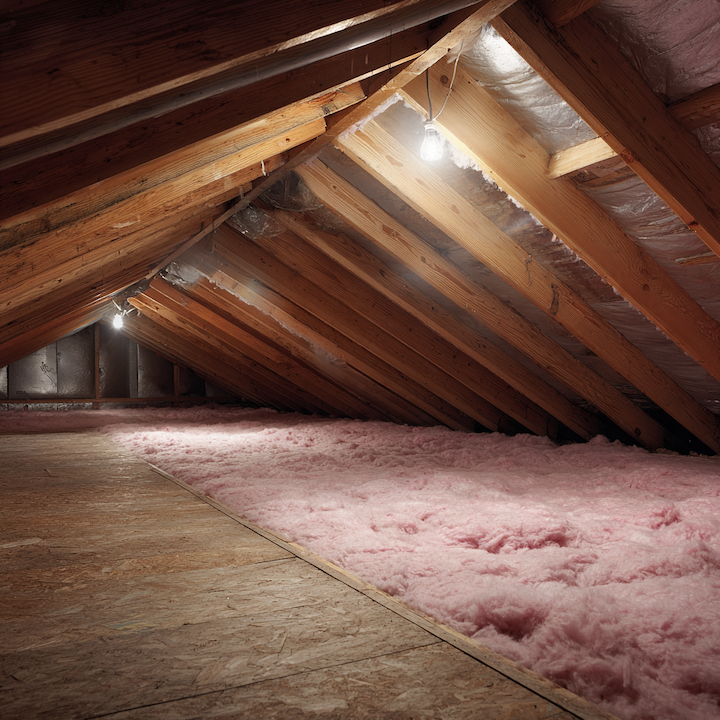
An East Memphis attic in late spring, up past the hatch for an inspection before closing. The seller had described the insulation as "good." From the hatch, it looked fine. Six inches out toward the eaves, the story changed.
Thirty-year-old fiberglass batts, compressed where someone stored boxes. Gaps where ductwork crossed the joists. At the exterior walls, the batts stopped six inches short of the top plates. A thermal camera showed those gaps running 30 degrees hotter than the insulated areas.
Memphis attics in July hit 140, sometimes 150 degrees. Any gap in the insulation becomes a highway for that heat to push into the living space. Across the metro, attic insulation runs $2.50 to $7.00 per square foot depending on type, and the difference between doing it right and doing it halfway shows up in the electric bill every month for the life of the house.
Two Houses, One Street
Two houses on the same Bartlett street, same builder, same floor plan. The homeowner in the first one had re-insulated to R-49 five years earlier. The second still had the original 1987 batts, R-19 when they were new but compressed and shifted after decades of service.
The second homeowner called her contractor after comparing summer electric bills with her neighbor.
"I've been watching this for three months," she said. "I'm pushing $320 a month. She's paying $180. Same system, same windows, same square footage. I don't know what else it could be."
He didn't need to guess. He'd been in her attic the previous fall, checking a bathroom vent that had come loose from the ceiling boot.
"Your insulation's shot," he said. "The batts have pulled away from the joists in at least three places I could see from the hatch. Hers is at R-49. Yours is maybe R-11 in the spots that still have contact."
"R-11." She did the math. "So I'm paying $1,700 a year more than I need to because of insulation that was garbage before my kids started school."
"That's the ballpark. Bringing yours to R-49 with blown-in fiberglass runs about $4,200 to $5,800 for this attic. If you go R-38, code minimum, you're closer to $3,600 to $5,000."
She was quiet for a second. "And she's been saving that since 2020."
"Five years at $140 a month. That's $8,400 she didn't send to MLGW."
That $140 monthly difference adds up to $1,680 per year. A 1,500 square foot attic insulated to R-49 with blown-in fiberglass costs $4,200 to $5,800. At R-38, the code minimum for Memphis attics, the same job runs $3,600 to $5,000. But the cost comparison only answers the first question homeowners ask. The second question -- how the insulation actually gets up there -- determines whether the job takes a morning or a week.
The Hose Through the Hatch
The Cordova house was a straightforward job. Twelve hundred square feet of attic, existing batts still in decent shape but only R-19. The homeowner wanted to bring it up to code.
The contractor walked her through it from the driveway, pointing at the attic vent near the ridge.
"Truck parks here. We run the hose up through the attic hatch and blow fiberglass over everything you've got. Doesn't take long. Two guys, two hours, maybe three if we run into anything."
"You don't have to tear the old stuff out?"
"Not unless it's wet or contaminated. Yours is fine. We just bury it."
She'd already gotten one quote. The other company had wanted to strip everything first. $5,800, three days, and they couldn't start for six weeks.
"I almost went with them," she said. "I figured if they wanted to remove it, there must be a reason."
"There wasn't. Your batts are dry and clean. Somebody was padding the ticket."
He wasn't tearing the other crew down. He walked her over to the attic hatch and pulled down the ladder so she could see for herself. No staining, no discoloration, no smell.
"The removal adds 40 percent to the cost," he said. "You're looking at about $3,200 for the overblow. Same job with removal runs closer to $5,800."
She brought up the gaps she'd noticed around the bathroom vent pipe. Daylight visible from inside the attic.
"That's a different problem," he said. He climbed two rungs up the ladder and pointed his flashlight at the pipe boot. Light leaked around every edge. "Blown-in fills around things, but it doesn't seal air leaks. The better crews handle that before we blow. Caulk around electrical boxes, foam around plumbing vents, seal the top plates."
"How much more is that going to cost me?"
"Three to six hundred dollars. But it can double the energy savings. Without it, you're putting a blanket over a house with the windows cracked."
She looked up at the hatch. "So the other company was going to charge me $5,800 and not even seal the leaks first."
"I can't speak to what they would have done. But I can tell you nobody mentioned it in their proposal."
Blown-in fiberglass installed over existing batts costs $2.80 to $3.90 per square foot. Air sealing before blowing adds $300 to $600 and can double energy savings. But blown-in handles one job -- thermal resistance. When the problem is air movement and moisture, the conversation shifts to spray foam.
Under the Roof Deck
The Germantown ranch had just had the roof replaced. The homeowner was standing in the garage with her insulation contractor, looking at the proposal he'd brought over.
"I keep thinking about the ductwork up there," she said. "We just spent $14,000 on a new roof. My HVAC is in the attic. The ducts are in the attic. And all of it sits in 150-degree air six months a year. I can't keep spending money on this house and still be uncomfortable in August."
"You're describing the argument for spray foam at the roofline," he said.
"Instead of the floor?"
"Instead of the floor." He picked up a scrap of rigid foam from the garage shelf and held it against his palm. "You spray the underside of the roof deck and the attic becomes part of the house. Semi-conditioned space. Your equipment and ductwork aren't fighting the heat anymore."
She looked at the two line items he'd written out. Open-cell at $3,900. Closed-cell at $7,500.
"That's a big spread."
"It is." He set the foam sample down and turned the proposal so she could see his notes. "Closed-cell is denser. About two pounds per cubic foot versus half a pound for open-cell. It bonds to the underside of the decking and adds rigidity to the roof assembly. And it's a vapor barrier on its own. Open-cell does the thermal job but you'd need a separate vapor retarder in this climate."
"Even at double the price?"
"You just put a new roof on. The foam bonds to the underside of the decking and makes the whole assembly stronger. And you won't have condensation problems three years from now." He paused. "The open-cell would work. But if you're protecting a $14,000 investment, I'd go closed-cell on a roof deck application."
"That's what I was afraid you'd say."
He smiled. "I could've led with the cheaper number."
Spray foam applied to the roof deck converts the attic to semi-conditioned space. Open-cell costs $2.60 to $3.60 per square foot. Closed-cell costs $4.70 to $6.50 and adds structural rigidity plus a vapor barrier. But spray foam and blown-in share a limitation -- they address the building envelope from the inside. Older Memphis homes often have a different problem: walls with nothing in them at all.
Nothing but Air
The Midtown bungalow was built in 1928. The homeowner found out about her walls by accident. The bathroom renovation had opened up a section of exterior wall and the contractor called her over.
"Come look at this."
She stared at the gap between the studs. Lath on one side, clapboard on the other, and nothing in between but eighty years of dust.
"There's no insulation at all?"
"Not a stitch. Common in houses this age. The whole exterior envelope is just air."
She put her hand inside the wall cavity. Cool air moved against her fingers from somewhere below.
"I can feel the crawl space," she said. "That's outside air coming up through the wall?"
"Straight up from underneath the house. Stack effect. Warm air rises out through your attic, cold air gets pulled in from the crawl through every gap in the framing."
She pulled her hand back and looked down the hallway. "Am I looking at tearing open every wall in this house?"
He shook his head. "Not necessarily. The standard approach for retrofit is drill-and-fill. We drill a two-inch hole between each stud from the outside, blow dense-pack cellulose or fiberglass into the cavity, plug the holes, and patch the siding. You'd never know we were there."
"What does that cost?"
"For wall insulation in a house this size, you're looking at $2.70 to $3.80 a square foot of wall area. But I'd be honest with you -- for most Memphis homes, the attic is where the money works hardest. That's where I'd start if you haven't done that yet."
"The attic's got maybe four inches of something up there. I don't even know what it is."
"Then that's your first call. Get the attic to R-38 minimum, R-49 if you can swing it. Then come back to the walls. The attic job will cut your bills enough that you'll have the savings to fund the wall work."
She asked about the crawl space. The floors had always been cold in winter.
"You've got a vented crawl. Your floor joists are sitting in humid Memphis air from April to October. Insulating the floor joists runs $4,400 to $6,100 for a thousand square feet. Encapsulating the crawl and insulating the walls down there instead of the floor changes everything -- $5,000 to $6,900 -- but it solves the moisture problem too. Different job, different conversation, but worth having."
Retrofitting wall insulation in older Memphis homes costs $2.70 to $3.80 per square foot of wall area. For most homes, attic insulation delivers the highest return per dollar spent. But even the right insulation at the right price doesn't help if the homeowner leaves money on the table with the utility company.
The Phone Call
The Collierville couple had the proposal on the kitchen counter. Blown-in fiberglass, 1,500 square feet of attic, R-49. $4,200. They were ready to sign when the contractor set his pen down.
"One thing before you write that check. Call MLGW and ask about TVA EnergyRight."
The husband looked up. "What is that?"
"TVA runs a rebate program for insulation upgrades. Up to $500 back. The work has to be done by a contractor in their Quality Contractor Network, but most licensed crews are already in it."
The wife was already reaching for her phone. "Nobody from the other two companies mentioned this."
"Most don't. It doesn't change the contractor's number either way, so a lot of crews skip it."
Twenty minutes on hold, five minutes of questions, and she had the paperwork started. Same job, same contractor, $3,700 after the rebate.
"We almost left $500 on the table," the husband said. "What about the federal tax credit? I read something about 30 percent back."
The contractor shook his head. "That was the 25C credit. It expired December 31, 2025. If you'd done this job last year, you could've claimed 30 percent of the insulation materials on your taxes. That ship has sailed."
"Is anything replacing it?"
"Tennessee's IRA Home Energy Rebate program is expected to launch third quarter of 2026. Different structure -- income-based, administered through TVA. Worth watching, but it's not available yet."
The wife did the math on the back of the proposal. $4,200 minus $500 TVA rebate. $140 a month in energy savings based on what their neighbor reported. Payback in under two and a half years, even without the federal credit.
"And every month after that is pure savings," the contractor said. "That's the part people forget."
TVA EnergyRight rebates return up to $500 on qualifying insulation upgrades through MLGW. The federal 25C tax credit expired December 31, 2025. Tennessee's IRA Home Energy Rebate program is expected to launch in Q3 2026. After the TVA rebate, payback on attic insulation typically runs 2 to 4 years.
The Contractor Question
A homeowner in Arlington did everything right last fall. She researched R-values, understood the difference between blown-in and spray foam, got three quotes, checked reviews online. She picked the lowest bid from a crew that showed up in an unmarked van with no license number on the truck.
They blew insulation over unsealed penetrations, left gaps at the eaves, and never installed baffles to keep the soffit vents clear. Three months later, moisture was pooling in her attic and the insulation had already started to sag.
She did the research. The contractor didn't do the work.
Every insulation contractor connected through this platform carries:
- Active Tennessee Board for Licensing Contractors license
- Monetary limit of $25,000 or higher
- $100,000 in general liability insurance
- Workers compensation for every crew member
- References called, not collected
- License verified directly with the state
- Vetted in person by someone with more than two decades in Memphis construction
None of that shows up in an online review.
Insulation connects to energy efficiency. Upgrades pair naturally with new HVAC systems. Window replacement addresses another major source of energy loss. And attic insulation often happens during roof replacement while the deck is accessible. Wall insulation upgrades coordinate well with siding replacement. Electrical work in the attic should happen before new insulation goes down.