Two Numbers and Not Enough Information
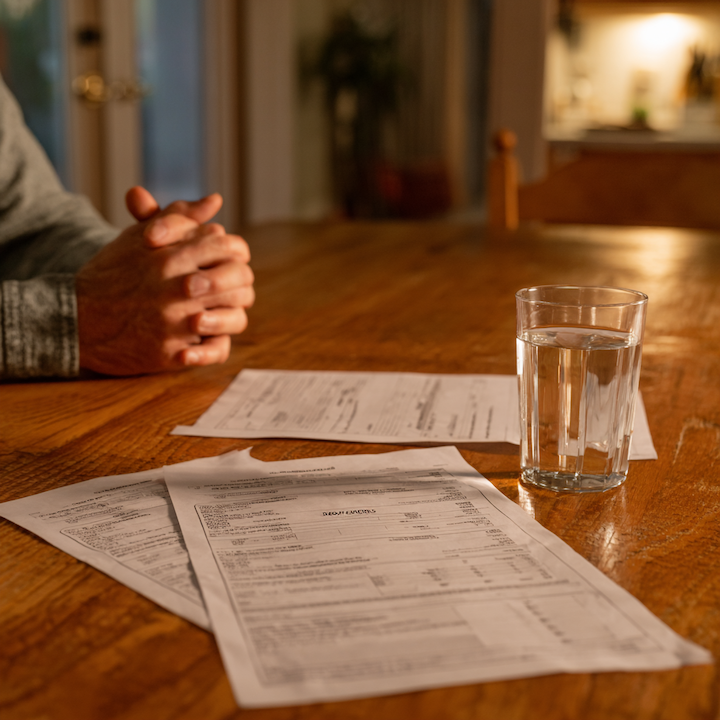
Two sheets of paper on a kitchen table. Two numbers that don't match.
A couple in Collierville last spring had three quotes for the same low water pressure problem. One plumber said $1,200 for a new pressure regulator. The second said $2,800 for a main line replacement. The third said $4,500 and wanted to repipe the whole house because he saw galvanized pipes in the crawl space.
The wife called the third plumber back.
"You're three times the first guy," she said. "For what looks like the same problem."
"I almost went with the first one. Twelve hundred dollars and done."
"The first guy wasn't wrong about the regulator. It is old. But the pressure's not dropping at the meter." He pulled up a photo on his phone of the pipe he'd scoped inside the wall. "The regulator controls pressure at the meter. But the pressure's dropping between the meter and your fixtures because these galvanized pipes are closing shut from the inside. New regulator on bad pipes buys you six months."
"And the second guy? The main line?"
"He's not wrong that the main line's old. But that's not where your pressure's disappearing. It's disappearing inside the walls."
"So I would've spent $2,800 and still had low pressure in the shower."
She looked at the three quotes spread across the table. Same house, same symptom, three completely different diagnoses.
"The first two weren't trying to take advantage of you," he said. "They just didn't scope the pipe."
Plumbing costs in Memphis range from $300 to $35,660 depending on what's actually wrong.
The Tank
A contractor walked into a utility closet in a Germantown split-level and put his hand on the side of the water heater. The homeowner stood in the doorway behind him.
"1997," the contractor said, reading the label. "You've gotten good years out of it."
"I flush it every year like the manual says."
"That's more than most people do. It's why you got 27 years out of a unit rated for 12."
He crouched down and ran his fingers along the bottom seam. "Feel this." He guided the homeowner's hand to a ridge of rust weeping along the base. "That's not sediment. That's the tank wall going."
"It still works fine."
"It does today." He stood up. "How old were you when you moved in?"
"Thirty-two. The kids were little."
"So this heater's been running since your kids were in car seats. Memphis hard water pushes sediment to the bottom faster than most cities. Once the tank wall starts weeping, there's no repair. Just a timeline."
"So I'm waiting for it to flood my utility closet."
"Not flood. Weep. It'll start slow -- a puddle you mop up once, then twice, then every morning. Most people replace it after the third morning."
"What's the difference if I do it now versus wait?"
"Right now I can schedule you next week. Pick the unit, plan the install, match it to your water usage. After it fails, you're taking whatever's on the truck."
She looked at the water heater the way someone looks at something they've already decided to replace.
Standard tank replacements for 40 to 50 gallon units run $1,020 to $4,020 depending on home size, age, and access. Electric tankless units run $1,950 to $6,500, gas tankless runs $3,230 to $11,100, and hybrid heat pump units run $3,600 to $12,410. Emergency replacements can double those numbers.
Nobody budgets for the thing that's still working.
The Pipes
A plumber cut into a wall in a 1960s Midtown bungalow to find the source of a slow shower. The homeowner was standing behind him when the drywall came off.
"Is that what it's supposed to look like?" she asked.
He held the flashlight so she could see. The galvanized pipe inside the wall was nearly closed shut. A quarter-inch opening where there should've been three-quarters.
"Mineral deposits," he said. "Forty, fifty years of Memphis water leaving a little behind every day." He tapped the pipe with his knuckle. It sounded dull. "You thought the low water pressure was normal?"
"I thought that's just what old houses did."
"Old houses with old pipes. These galvanized lines last 40 to 60 years. Yours are right at the end."
"I had a plumber out last year for the kitchen faucet. He replaced the aerator and said that should fix it."
"It probably did fix the kitchen. For a while."
He set the flashlight down. "You see any gray plastic pipe anywhere in the house?"
"Is that what I have?"
He shined the flashlight further. "No, yours is galvanized steel. The good news is galvanized announces itself. Polybutylene just quits." He looked back at her. "Gray plastic pipe, installed from '78 to '95. Looks fine from the outside while it degrades from the inside. When it goes, it goes all at once."
"How much are we talking to replace all of it?"
"PEX runs $7,080 to $24,560 depending on the size of the house and foundation type. Copper's more at $9,360 to $32,700. Slab foundation adds 30 percent because the access is harder."
"Which one do most people go with?"
"PEX. Ninety percent of the repipes I do in Midtown are PEX. Copper's a better pipe but the install cost puts it out of reach for most people in this price range."
She looked at the pipe in the wall and then back at him. "So every faucet in this house is pushing water through that."
"Every one."
She turned the faucet on in the hallway bathroom. The stream came out thin and uneven.
"I thought I just needed a new showerhead," she said.
That's the kind of number that changes the conversation.
The Line
A home buyer in East Memphis had the sewer scoped before closing. The plumber fed the camera in through a cleanout in the front yard while the buyer watched the screen on the truck.
"What am I looking at?" the buyer asked.
"Clay tile. Original to the house, so about 60 years old." The camera pushed forward. "See those white threads coming in from the joints? That's roots. They find the moisture at every seam and work their way in."
The screen showed roots filling half the pipe.
"So that's been backing up into the house?"
"Not yet. Right now the roots are slowing the flow. Another year, maybe two, and you'll get backup after a heavy rain. That's when most people find out."
"I can cut the roots today and the line will flow. But they'll be back in 18 months because the joints are where they're getting in. Cutting roots in a compromised clay line is maintenance, not repair."
"How long are you planning to be in this house?"
"Fifteen, twenty years at least. We're done moving."
"Then you want the full replacement. Spot repair makes sense if you're selling in five years. But if you're staying, you don't want to be out here again."
Spot repair on the bad sections runs $2,050 to $6,580. Full traditional replacement runs $8,950 to $12,430. Trenchless methods cost $11,460 to $15,910 but don't tear up the yard.
"Can I use this to negotiate the price down?"
"Every buyer who scopes a sewer line before closing uses it at the table. The seller already knows the line's old. The camera just gives you the number."
The buyer looked at the house, then at the screen, then at the house again.
"The house is worth it," the plumber said. "The line isn't the house."
A sewer scope costs $410 to $580. That's the most valuable money a buyer can spend before closing on an older Memphis home.
Some problems don't show up until someone's standing in the yard with a camera.
The Slab
The water bill in a Bartlett ranch house doubled in one month. No dripping faucets. No running toilets. No visible leaks anywhere.
The homeowner called a plumber who ran a pressure test on the hot water line. It failed.
"You've got a leak under the slab," he said. He was standing in the living room, pointing at the floor. "Hot water line corroded through somewhere between here and the water heater. It's been leaking into the ground under the foundation."
"So I've been paying for water that's been leaking into the ground this whole time?"
"Probably two or three months based on that bill. Hot water line leaks are slow. You wouldn't see it or hear it. The water bill is usually the first sign."
"Three ways to go." He held up a finger. "Reroute through the attic. New line goes up and over instead of under. That's $2,000 to $6,000. Avoids the slab entirely." Second finger. "Tunnel under the foundation from the outside. $1,500 to $4,500. Less invasive but slower." Third finger. "Jackhammer through the slab, fix the pipe, patch the concrete. Gets to the exact spot but adds dust, mess, and cost."
"The jackhammer. What does that do to my floors?"
"Depends on what's down. Tile, you're replacing it. Carpet, we can pull it back and relay. Either way you're living somewhere else for three to five days."
"Which one would you do?"
"In a ranch on a slab? Reroute. The pipe under there is the same age as the one that failed. Fixing one section means waiting for the next one to go."
"How much is the reroute?"
"On a ranch this size, $2,000 to $6,000 for the attic path. And you never think about what's under the slab again."
She looked down at the living room floor. "So there's a pipe under here right now, leaking."
"Was leaking. I shut the valve off when the test failed. Your floor's fine. The ground absorbed it."
Slab plumbing repairs almost always cost more than crawl space or basement access. The foundation isn't the problem. It's the barrier between the plumber and the pipe.
The Call
A burst supply line at 2 AM in a Cordova laundry room put two inches of water on the floor before the homeowner found the shutoff valve. The emergency plumber was there in 40 minutes. The repair took an hour. The bill was $450.
The homeowner asked the plumber what it would've cost during business hours.
"About $150," he said. He was packing his tools, standing in a puddle. "Same repair. Same parts. Same time."
"Three hundred dollars for it being 2 AM."
"For someone being available at 2 AM." He set his bag by the door. "I had a guy on call tonight. He left his house, drove 25 minutes, fixed your line. That premium keeps a crew available for the call that can't wait until morning."
"If I'd called at 8 AM instead?"
"I'd have been here by 10. Same fix. You'd have had to shut the valve and put towels down for the night."
"How do I know what can't wait?"
"If you can shut the water off and it stops, it can wait. If you can't find the shutoff or the water won't stop, that's the call."
Emergency rates run 2 to 3 times standard pricing. The premium isn't markup. It's the cost of the truck that's already rolling when the water won't stop.
The homeowner looked at the wet floor and then at the valve handle on the wall behind the washing machine.
"I didn't even know that was there," he said.
"Most people don't. Until 2 AM."
It's a hard call to make when the floor's already wet.
The Contractor Question
A couple in the Cooper-Young area tried to get a 1948 bungalow repiped. They'd hired a plumber off a yard sign. He quoted $4,800, took $2,400 upfront, and started cutting drywall on a Monday. By Wednesday he stopped showing up. They found PEX connections crimped with the wrong rings and three joints that were never pressure-tested. The water was off for nine days.
They needed it done right this time. But every plumber's website said the same things. Same stock photos of clean copper joints. Same "licensed and insured" badges. Same promises about showing up on time.
They still had no way to know.
Every plumbing contractor connected through here carries an active Tennessee Board for Licensing Contractors license with a monetary limit of $25,000 or higher. They maintain $100,000 in general liability insurance and carry workers compensation for every crew member on the job. Their references were called, not collected. Their license was verified directly with the state. They were vetted in person by someone with more than two decades in Memphis construction.
That's the part that doesn't show up in a Google search.
Plumbing connects to wet areas and systems. Bathroom remodels drive most residential plumbing work. HVAC installations sometimes require gas line modifications. And leaks under slabs can lead to foundation concerns. Kitchen renovations frequently involve sink relocations and dishwasher lines. Persistent moisture below grade may call for waterproofing.