Seventy Years of Settling Behind the Frame
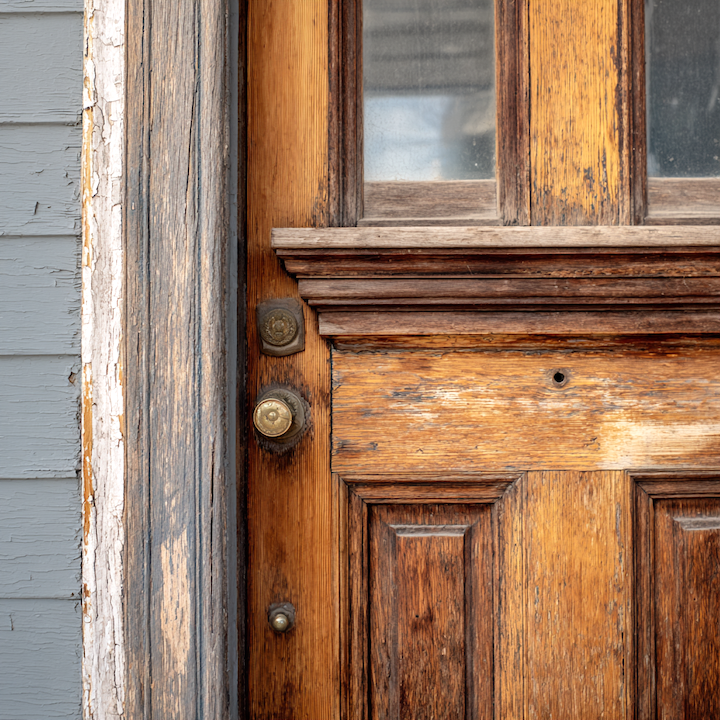
Memphis has 70 years of housing stock sitting behind its front doors. Pier-and-beam bungalows in Midtown where the frames have settled out of square. Slab-built ranches in Cordova where the patio sliders haven't sealed properly since the rollers wore down. Colonials in Bartlett where every hollow-core interior door echoes through the hallway.
Two quotes for the same entry door replacement in East Memphis last spring. One at $1,450. The other at $2,250. Same fiberglass slab, same factory finish, same rough opening. The difference had nothing to do with the door.
Door replacement across the metro runs $315 for a basic interior to $15,738 or more for a custom double entry with full frame replacement. Most of the spread lives in what comes off before the new door goes on -- the frame condition, the opening geometry, and whether the threshold and weatherstripping can stay or have to go.
The Frame
An installer tried to hang a new entry door in a bungalow off Central built in 1948. He'd measured the opening twice before ordering. The door arrived factory square, fresh weatherstripping, ready to go.
It wouldn't fit.
The homeowner stood in the hallway behind him. "I've been saving for this door since August," she said. "Please don't tell me I ordered the wrong size."
"Nothing's wrong with the door." The installer held his level against the jamb. "Your opening is an inch and a half out of square. Wider at the top, one side leaning in." He ran his hand down the old frame. "This thing's been shimmed and trimmed and shimmed again for 70 years."
"So it's the house."
"It's what houses on piers do." He set the level down. "I need to reframe this opening before the door goes in. Otherwise it'll bind in summer when the wood swells and gap in winter when it shrinks. You'll be fighting it every season."
She looked at the door leaning against the porch rail. "How much more?"
"About $650 on top of the install. Three hours of framing before the door can hang."
"So my $1,600 door is now $2,250."
"Your $1,600 door was always $2,250. The first quote just didn't look behind the trim."
She sat down on the step. "The guy who quoted $1,450 -- he wasn't going to reframe it, was he?"
"Probably not. And you'd have been calling somebody by February." He picked up his framing square. "I'd rather you be mad at me for the number now than mad at the door in six months."
What should have been a $1,600 job became $2,250. The door was never the expensive part.
Older Memphis homes settle. The ones built on piers in Midtown and Cooper-Young shift more than the ones on slabs. Over decades, door openings drift out of square. Prehung doors include the frame, hinges, and weatherstripping in one unit. They cost more than slab doors but install faster and seal better. Reframing adds $554 to $770 when the opening won't accept a standard unit.
The new door is always waiting on the old house to let it in. But once the opening is right, the question becomes what to put in it.
The Material
A homeowner in Germantown had been painting the same entry door for 30 years. Six coats, each one covering the last, building up in the panel grooves until the detail was almost lost.
"I thought it just needed another coat," she told the contractor. "I've been putting it off because I didn't want to deal with the prep."
He pressed his thumb against the bottom rail. It gave.
"Feel that?" he said.
She pressed. Her face changed.
"Water's been wicking up from the threshold for years," he said. "The paint held the moisture in. The wood rotted from the inside out while the surface looked fine." He pulled a putty knife from his belt and slid it under the paint at the bottom corner. The blade went in without resistance. "By the time the damage shows through the paint, you're past saving it."
"I've been painting over rot for how long?"
"Hard to say. Five years, maybe more. The paint was doing the worst possible thing -- sealing moisture in where you couldn't see it."
"So it has to go."
"It does. But this time you've got options that don't need painting every three years." He pulled up photos on his phone. "Steel entry doors run $1,057 to $2,234 installed. Least expensive option, but a steel door on a south-facing entry like yours will show rust at the bottom edge within five years if the drip cap isn't right." He swiped. "Fiberglass runs $1,451 to $3,764. Doesn't absorb moisture, doesn't rot, doesn't need refinishing. Most of the spread comes from glass. A solid slab with no window sits at the low end. Half-lite or full-lite with decorative glass pushes toward the top."
"What about wood again?"
He didn't laugh. "Starts around $1,766 and runs past $8,675 for a custom carved double entry. Beautiful doors. But Memphis gets rain, humidity, and south-facing sun in the same afternoon. Wood needs refinishing every two to three years or it ends up right back where you are now."
She looked at her front door. "How much would a refinish have cost five years ago?"
"About $200."
She was quiet for a moment. "I spent $3,600 replacing a door that $200 would have saved."
"Nobody budgets for the maintenance that prevents the replacement. You're not the first person standing here doing that math."
She'd spent $3,600 on a premium fiberglass entry with full frame work because the old threshold was gone along with the door. Nobody budgets for the maintenance that prevents the replacement. Steel entry doors run $1,057 to $2,234 installed in the Memphis metro. Fiberglass runs $1,451 to $3,764. Wood starts at $1,766 and climbs past $8,675 for custom stain-grade double entries.
Exterior doors get the attention because every visitor sees them. Interior doors get ignored until somebody puts a fist through one.
The Interior
A buyer in Bartlett walked through a 1990s colonial with his agent. Every door echoed when it closed. A flat, papery sound instead of a solid thunk.
The agent opened the master bedroom door and pointed at a hole punched through it at doorknob height.
"Hollow-core throughout," she said. "All of them."
"I didn't even know there were different kinds," the buyer said. "I thought a door was a door."
The contractor they'd brought along knocked on the door with his knuckle. It sounded like a drum. Then he knocked on the hallway wall. Solid.
"Hear the difference?" he said. "Hollow-core is a frame with a paper honeycomb inside and a thin skin on each face. Weighs maybe 15 pounds. Provides visual privacy and that's about it."
"And solid-core?"
"About three times the weight. Composite core that blocks sound and absorbs impact." He gestured down the hallway. "Three bedrooms off this hall. With hollow-core, you hear every conversation through the door. With solid-core, you hear none of them."
The buyer pressed his hand flat against the damaged door. His fingers flexed and the skin bowed inward. "So my kids would go through these in a year."
"A year would be generous."
The buyer looked at the agent. She nodded.
"Buyers notice," she said. "Inspectors note it. And every time a door closes in a showing, people hear the difference even if they can't name it."
The buyer turned to the contractor. "What does it cost to swap all of them?"
"Depends on count and what you're putting in." He walked the hallway, counting. "Ten doors in this house. Hollow-core prehung with builder hardware runs $315 to $438 per door. Solid-core with Kwikset or Schlage runs $492 to $684. The upgrade from hollow to solid across all ten adds roughly $2,000 to the project."
"And we'd bundle it."
"Installers price bundled work lower per door than one-offs. A ten-door project averages $492 to $684 per door compared to $750 or more for a single."
A seller in Raleigh spent $6,500 replacing all 12 interior doors before listing. The agent said the hollow-cores made the house feel cheaper than it was. Twelve doors changed the way the whole house sounded. Hollow-core prehung runs $315 to $438 per door installed in the Memphis metro. Solid-core runs $492 to $684. Bundled work drops the per-door cost as the count goes up.
Swing doors are straightforward -- the hardware is the only moving part. Sliding doors have rollers, tracks, and weatherstripping that all fail on different timelines.
The Slide
The sliding door in a Cordova ranch hadn't moved smoothly in five years. The homeowner met the contractor at the back of the house, already apologizing for the door.
"You have to lift and pull at the same time," she said, demonstrating. The door lurched along the track. "I use a broomstick for security because the lock hasn't caught in three years."
"How long have you been doing the lift-and-pull?"
"Since the first winter we were here. I figured it was just an old door."
He crouched down and looked at the track. Ran his finger along it.
"Rollers are shot," he said. "Metal's been grinding on metal. See these grooves?" He pointed at the scored aluminum. "And the weatherstripping compressed into a hard ridge. It's not sealing anything." He held his hand along the bottom of the closed door. "Feel that?"
She crouched beside him. Air was moving through the gap.
"I've been air conditioning the backyard for five years?"
"Part of it." He stood up. "Roller replacement runs $226 to $732. That's the fix if the track is still smooth. But yours is scored. Track repair adds $301 to $1,046." He slid the door open again, and it caught halfway. "If the track had been fine, new rollers three years ago would've solved it for under $250."
"And now?"
"Now the track damage means full replacement makes more sense. A vinyl sliding door retrofit runs $1,932 to $2,683 depending on size. Fiberglass and wood run higher. French door pairs in an existing opening run $1,751 to $6,368 installed."
She stared at the door she'd been fighting for five years. "So the $226 fix I didn't get turned into a $2,683 replacement."
"Some repairs have an expiration date."
The energy bill told the rest of the story. Conditioned air had been leaking through that seal gap every month for five years. Roller replacement runs $226 to $732 when the track is intact. Once the track is damaged, full sliding door replacement runs $1,932 to $2,683 for vinyl and higher for premium materials. French door pairs run $1,751 to $6,368 installed.
The door and the frame and the installation get the budget. The hardware gets whatever is left over. That's usually a mistake.
The Hardware
A seller in Collierville had done everything right. New fiberglass entry door, factory stained to look like mahogany. $1,500 for the door and installation. It looked like the cover of a home magazine.
Her agent came by the next day for the listing photos.
"Where'd you get the lockset?" the agent asked.
"Hardware store. $80."
The agent put her hand on it. Brushed nickel, builder grade. It sat loose in her palm, and the finish was visibly thinner than the door's factory mounting plate.
"You put $1,500 into the door and $80 into the first thing a buyer touches."
"It works fine. It locks."
"So does every lockset. That's not the point." The agent stepped back to the sidewalk. "From here, the mismatch between the door and the hardware is obvious. The door says $1,500. The lockset says $80. Buyers feel that even if they can't articulate it."
"Nobody's going to walk away over a lockset."
"Nobody walks away over a lockset. But it starts a mental list. The lockset, then the baseboard, then the grout, then they're wondering what else got the cheap option." She walked back to the door. "Kwikset or Schlage handleset, $126 to $437. That matches this door. Smart lock with keypad or app runs $315 to $984. Emtek or Baldwin starts around $472 and runs past $2,624 for solid brass estate sets."
The seller looked at her front door. "You're telling me a $140 handleset changes how people see a $300,000 house."
"I'm telling you an $80 handleset changes how people feel about it. And they make offers based on how they feel."
The first showing confirmed it. Comment about the front door. Not the door itself. The lockset. The seller replaced it with a $140 Schlage handleset the next day. $80 saved, then spent again plus $60 more. Builder-grade hardware runs $79 to $262. Kwikset and Schlage handlesets run $126 to $437. Smart locks run $315 to $984. Designer hardware from Emtek or Baldwin starts at $472 and runs past $2,624 for solid brass estate sets.
The cheapest part of the door ended up being the most expensive decision. But the right door, the right frame, and the right hardware still depend on who puts them together.
The Contractor Question
I watched a couple in Bartlett do everything right last fall. Three quotes. Three companies with websites and five-star reviews. Professional trucks. Salesmen who said all the right things about materials and timelines.
They still had no way to know.
No way to tell which crew would answer the phone in January. No way to know if the installer actually carried workers comp or just said he did. No way to verify a license number they wouldn't think to ask for.
That's the gap this platform exists to close.
The door contractor connected through here holds an active Tennessee Board for Licensing Contractors license with a monetary limit of $25,000 or higher. They carry $100,000 in general liability insurance and workers compensation for every crew member on the site. Their references were called, not collected. Their license was verified directly with the state. They were vetted in person by someone with more than two decades in Memphis construction.
That's the part that doesn't show up in a Google search.
Most estimator sites work by collecting your contact information and selling it to three to five contractors who then compete for your business with aggressive follow-up calls. This platform works differently. When you request a contractor introduction, we match you with one door installer whose licensing, insurance, and work history have already been verified. One contractor, one homeowner, one conversation. No bidding wars and no phone spam.
The estimator itself requires nothing from you. No account creation, no email address, no phone number. Run as many estimates as you want, adjust the door types, compare entry against patio against interior -- all of it happens in your browser using current Memphis pricing data. Your information stays yours until you decide otherwise. The only time we ask for contact details is when you choose to connect with a verified contractor for a formal bid.
Door projects connect to the building envelope. Entry doors often get replaced alongside windows for a unified look. Exterior painting refreshes the trim once new doors are hung. And interior door upgrades are a common part of bathroom remodels and kitchen renovations. New door heights sometimes require flooring transitions to be adjusted.