The Difference Is Under the Paint
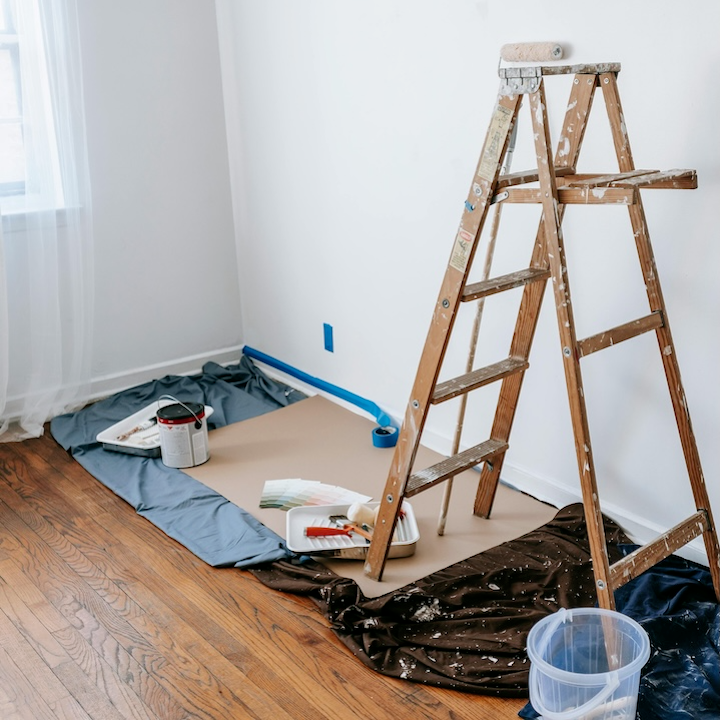
The hallway in a Cordova flip looked finished. Fresh paint, new baseboards, staged furniture at both ends. A buyer's agent walked the house with her clients on a Saturday afternoon, and neither one noticed anything wrong until the husband leaned against the wall near the laundry room and felt it give.
The couple had already gotten two quotes to repaint the whole house before move-in. One came in at $4,800. The other at $8,200. Same house. Same color. They could not figure out the difference.
The contractor they called for a third opinion ran his hand along the hallway wall. He stopped above the baseboard and pointed.
"Come here," he said. He pressed a thumb into a nail pop. Then another. A line of them ran the length of the hallway. He opened the hall closet. Inside, three old patches showed through the flat paint like bruises under a sunburn. "That first crew is rolling over all of this. My crew is fixing it first."
"So the difference between $4,800 and $8,200 is what's under the paint?" the wife asked.
"On this house? About 40 percent of my price is prep. Patching, sanding, priming every repair. The walls have to be right before the roller touches them, or the paint just decorates the damage."
She looked at the hallway again. From 10 feet away, the walls looked fine.
Prep work accounts for 30 to 40 percent of total labor time on a Memphis interior repaint. Professional crews charge $2.00 to $3.50 per square foot of wall space. The low end assumes walls in good condition. The high end means real prep happened before the first coat went on. A whole-house walls-only repaint at standard quality in Memphis runs $6,600 to $8,800. Most of the disagreement between two painting quotes starts right there. That range moves based on paint quality, scope, and what the walls need before the color goes on.
Color Changes
A homeowner in Bartlett had been staring at her burgundy living room for 4 years. She met the contractor with a paint chip in her hand.
"I want this gray," she said. "Same as the rest of the house. I should have done it the first time."
He pulled a putty knife from his belt, found a spot behind the door where the baseboard met the wall, and scraped a thin line through the paint. Two layers of burgundy over a pinkish primer. He held the blade up next to her gray chip.
"See the undertone?" he said. "Burgundy has red pigment that bleeds through latex. Gray won't cover this. Not without a high-hide primer underneath."
"How many coats are we talking about?"
"Two coats of primer to block the bleed. Then two coats of finish. On a room this size, the primer alone adds about $400."
She set the chip on the windowsill. "So the color I picked 4 years ago is going to cost me twice."
"Dark to light always does."
Dark-to-light color changes add $0.50 to $1.00 per square foot in extra material and labor. Two coats of high-hide primer plus two coats of finish effectively double the coat count. The color that is already on the wall matters as much as the color going over it. But once the surface is prepped and the color is settled, the next question is which paint goes on -- and what it costs per square foot.
The Paint
The contractor spread three sample cards across a kitchen counter in Germantown. Each one had two brush strokes of the same gray, side by side. The homeowner had already picked her color. She had not picked her paint.
"These are all the same gray?" she asked.
He pointed to the first card. "This is a standard contractor-grade latex. Solid coverage, two coats, gets the job done." He moved to the second. "This is a premium acrylic. Better adhesion, better washability, holds color longer in direct light." He tapped the third card. "This is a designer line. The pigment density is different. You can feel it on the brush. One coat covers what the standard needs two for."
She ran a finger across each stripe. "I can see the difference in the third one. It's richer."
"It is. And it's roughly double the cost per square foot. On a whole house, walls only, standard quality runs $6,600 to $8,800. Premium takes that to $9,200 to $12,300. Designer grade is $13,200 to $17,600."
"So the paint alone is a $6,000 swing."
"The paint and the labor that goes with it. Better paint is thicker, heavier, takes more skill to cut a clean line. The crew that applies designer grade charges more because the finish has to be flawless. You see every imperfection in a high-pigment paint."
She looked at the third card again. "What would you put in your own house?"
"Premium. Designer is beautiful, but premium is the sweet spot. You get the durability and the washability without paying for pigment density most people can't tell apart after 6 months."
Interior painting in Memphis runs $2.09 to $4.19 per square foot for walls only, depending on quality tier. Standard paint at $2.09 per square foot delivers a clean finish that lasts 5 to 7 years. Premium at $2.93 per square foot adds washability and color retention. Designer grade at $4.19 per square foot is for homeowners who want the highest pigment density and finish quality. Adding ceilings increases the total by roughly 50 percent. Adding trim doubles it. The scope determines the final number as much as the quality.
Vacant or Occupied
The contractor had painted a 2,400 square foot house in Collierville the week before. Three days, start to finish. Empty rooms, no furniture, no drop cloths over somebody's couch. The homeowner who called him today had the same square footage but a different situation entirely.
"We're living in it," she said. "Two kids, a dog, and my husband works from home in the back bedroom."
He walked the rooms, measuring furniture clearances and noting doorways.
"I just finished a vacant house this size in Collierville," he said. "No belongings to cover, no schedules to work around. Three days."
"And mine?"
"Five. We're moving furniture twice per room, laying plastic over everything, and painting around your husband's office hours. We can't spray -- we have to roll and brush because your family is living in the space."
She did the math. "So I'm paying for 2 extra days of labor because we didn't time this right."
"You're paying for the time it takes to protect what's already in the rooms. On a job this size, that's about $600 to $700 more than the same house empty."
"We close on the new house in March. If I'd waited--"
"You'd paint it the week of closing. Empty house, full access, no restrictions. That's the cheapest day to paint."
Vacant-home rates run 10 to 15 percent lower than occupied-home rates. For a $5,000 job, that is $500 to $750 saved just by timing it right. Empty houses eliminate furniture moving, drop cloth protection, and schedule coordination. A crew that finishes a vacant house in 3 days needs 5 days occupied. The logistics change, not the paint.
Cabinets and Trim
A homeowner in East Memphis pointed at her kitchen cabinets while the contractor was scoping her interior repaint.
"Can you just paint these while you're here?" she asked. "Same crew, same trip. Should be cheaper that way."
He opened one of the upper cabinet doors and looked at the hinge. He pressed a thumbnail into the edge of the door where the factory finish met the wood. The coating flexed but did not chip.
"These are thermofoil," he said. "The surface has to be chemically deglossed and primed with a bonding agent before any paint goes on. Then every door, every drawer front comes off. They get sanded, primed, and sprayed in a garage or a shop. Two to three coats minimum. Then they come back and get reinstalled with new hardware if the old stuff doesn't line up."
"That's not just painting."
"No. That's refinishing. And it's a different quote."
She opened a drawer. "What if I just want the frames and leave the doors?"
"I'd still quote it separately. Cabinet work requires spray equipment, bonding primers, and curing time between coats. It's not the same crew or the same process as rolling walls."
Cabinet painting runs $3,000 to $8,000 for a typical Memphis kitchen. It requires door removal, sanding, priming, multiple spray coats, and reinstallation. It gets lumped into interior painting quotes where it does not belong. Trim work also carries its own pricing. Baseboards, door frames, and crown molding run $1.00 to $2.50 per linear foot. Both should be quoted as separate line items, not buried inside a wall painting number. That is where most of the surprises hide in a painting estimate.
Timing
A realtor in Midtown called the contractor on a Wednesday. She needed a flip painted before a Monday showing. Five days. Three bedrooms, two bathrooms, and a hallway.
"Can you get it done?" she asked.
"I can get it done," he said. "But I'm pulling my crew off a scheduled job to do it." He opened his calendar on his phone and turned the screen toward her. Every day through the following week was blocked. "That carries a premium."
"How much?"
"15 to 25 percent over what I'd quote with 2 weeks of lead time. On this job, that's an extra $700 to $800."
She was quiet for a moment. "And if I'd called 2 weeks ago?"
"You'd have gotten the lower number, the same crew, and I wouldn't have to reschedule another client to fit you in."
"So I'm paying for my own scheduling."
"You're paying for availability. The painters who are available tomorrow are either between jobs or charging a premium to rearrange their calendar. Two weeks out, you get the regular price and the crew that's already planned for your job."
Rushed timelines carry premiums of 15 to 25 percent over standard scheduling. Two weeks of lead time gets better pricing than a last-minute call. Fall and winter bookings offer easier scheduling and better availability since interior work is climate controlled and runs year-round. The painters who show up matter more than the paint they bring, which is the part that no scheduling trick can solve.
The Contractor Question
A homeowner in East Memphis did what most people do when they need three bedrooms and a hallway painted. She found a crew on a neighborhood app. The price was right. They showed up on time. And when they left 2 days later, every wall had visible roller marks, the ceiling lines were uneven, and there was latex spatter on the oak trim.
She wanted to get it redone properly. But she had the same problem she started with. Painting looks simple enough that anyone with a brush can claim the title. Telling the difference between a crew that masks and cuts clean lines and a crew that rolls fast and moves on is almost impossible from a quote.
That is the gap this platform exists to close.
The painters connected through here hold an active Tennessee Board for Licensing Contractors license with a monetary limit of $25,000 or higher. They carry $100,000 in general liability insurance and workers compensation for every crew member. Their references were called, not collected. Their license was verified directly with the state. And they were vetted in person by someone with more than two decades in Memphis construction.
That is the part that does not show up on a neighborhood app.
Interior painting connects to refresh projects. Paint often follows new flooring installation. Kitchen updates call for fresh walls. And finishing a basement means painting everything from scratch. Bathroom remodels need moisture-resistant finishes on walls and ceilings. New interior doors and casings require priming and painting to match.